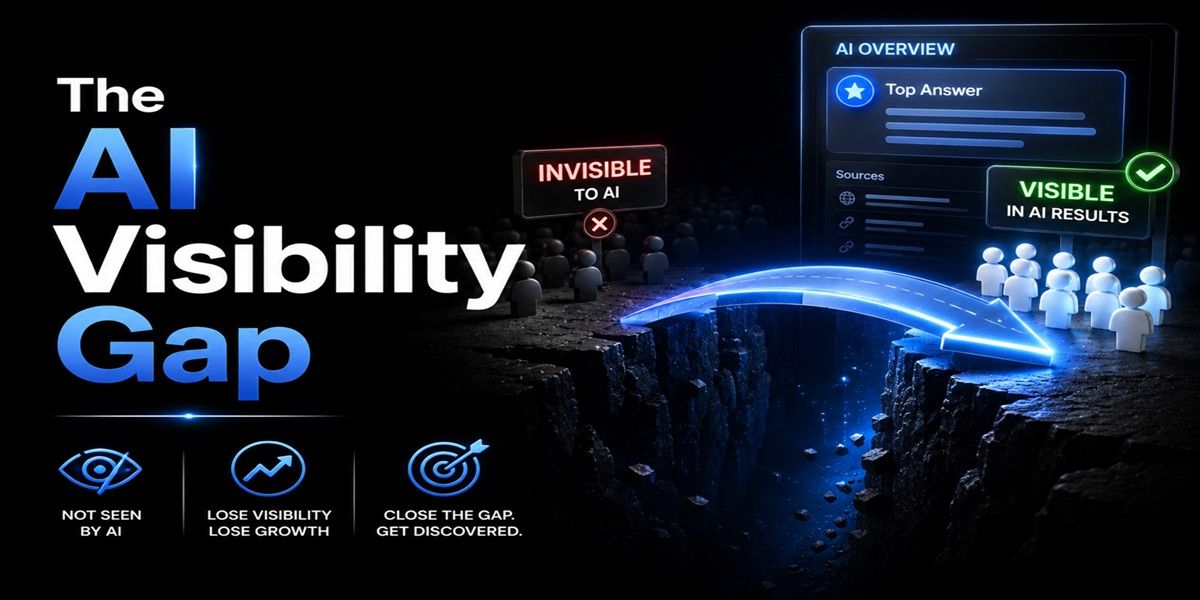

A prospect opens ChatGPT and types: “best [category] tools for a 50-person sales team.” Five vendors get named. Yours isn’t one of them – even though you rank on page one of Google for the exact same query.
This is happening across B2B SaaS right now, and most marketing teams haven’t noticed because they’re still measuring the wrong thing. Google Search Console tells you nothing about whether Perplexity cited you in an answer, or whether ChatGPT’s shopping mode recommended your competitor instead.
Buyers have already moved the research step upstream
The old B2B funnel assumed a buyer would eventually land on your website, read a comparison page, and fill out a demo form. In 2026, a growing share of that research happens entirely inside an AI conversation, before any website visit occurs. The buyer asks a chat interface to shortlist vendors, asks follow-up questions about pricing and integrations, and only visits 2-3 sites – the ones the AI already named.
If your brand isn’t in that first answer, you don’t lose the deal. You never entered the deal. There’s no “second page” in a conversational answer the way there is in Google search.
We’ve been tracking this by monitoring several hundred commercial B2B queries a day across ChatGPT, Perplexity, and Google’s AI Overviews. The pattern is consistent: citation share is concentrated among a small number of sources per query, and it correlates weakly with traditional domain authority. A well-structured mid-authority page regularly out-cites a high-authority page that isn’t written for extraction.
Why traditional SEO doesn’t automatically transfer
Ranking well in Google and getting cited by an LLM are related but distinct problems. Google’s ranking algorithm evaluates a page in the context of a search results list – it can win on backlinks, freshness, and click behavior even if the page itself is only moderately clear. An LLM generating an answer works differently: it retrieves candidate passages, and it favors the ones that most directly and unambiguously answer the implied question, with enough surrounding context to be confident about attribution.
In practice, that means three things B2B SaaS content teams routinely get wrong:
-
The answer is buried, not led with. Most B2B comparison and category pages open with a paragraph of positioning (“In today’s fast-paced digital landscape…”) before getting to anything concrete. LLMs weight the first substantive claim heavily. If your differentiators show up in paragraph four, they’re competing with pages that stated theirs in paragraph one.
-
Entities aren’t disambiguated. If your product name is generic, shares a name with something else, or is never paired with a clear category descriptor (“[Product] is a [specific category] for [specific buyer]”), models have a harder time confidently attributing claims to you versus a competitor with a clearer entity signal.
-
There’s nothing to corroborate the claim. LLMs lean on convergent evidence – the same claim appearing, in compatible form, across multiple credible sources. A single self-published blog post making a strong claim about your product is weaker signal than that same claim being echoed on a review site, a comparison roundup, and your own docs.
Four fixes that move the needle in 60 days
Audit your current citation rate before changing anything. Pick the 15-20 queries your ICP is most likely to ask an AI assistant when evaluating your category (not just your brand name – category and comparison queries). Run them manually across ChatGPT, Perplexity, and Google AI Overviews, and log who gets cited. This becomes your baseline and your competitive map.
Rewrite your top three commercial pages answer-first. For your category page, your comparison/alternatives page, and your pricing page, put the direct answer to the implied question in the first two sentences. Save the narrative framing for later in the page – or cut it.
Add explicit entity anchoring. Every page that matters for AI visibility should state, near the top, what your product is, who it’s for, and what category it belongs to, in plain declarative language. Don’t assume the model already knows your brand – most B2B tools are outside the long tail of general model training data.
Build corroboration deliberately. Identify 3-5 credible third-party surfaces where your category gets discussed – review platforms, independent comparison sites, relevant subreddits or communities, and industry roundups – and make sure accurate, current information about your product exists there. This is slower than content production but it’s the signal LLMs actually weight most heavily for trust.
The window is still open
Because AI-answer citation patterns are new and still forming, the current set of “default” cited sources per query isn’t locked in the way Google’s top 10 often is for competitive terms. Teams that treat this as a structural content and entity problem – rather than a copywriting tweak – have a real opportunity to become the default citation in their category before it calcifies.
If you want a starting point, AGI Agent World’s agent-readiness assessment gives a quick read on how discoverable and citable a brand currently is across major AI assistants – useful as the baseline step described above, whichever tool you end up using to track it.