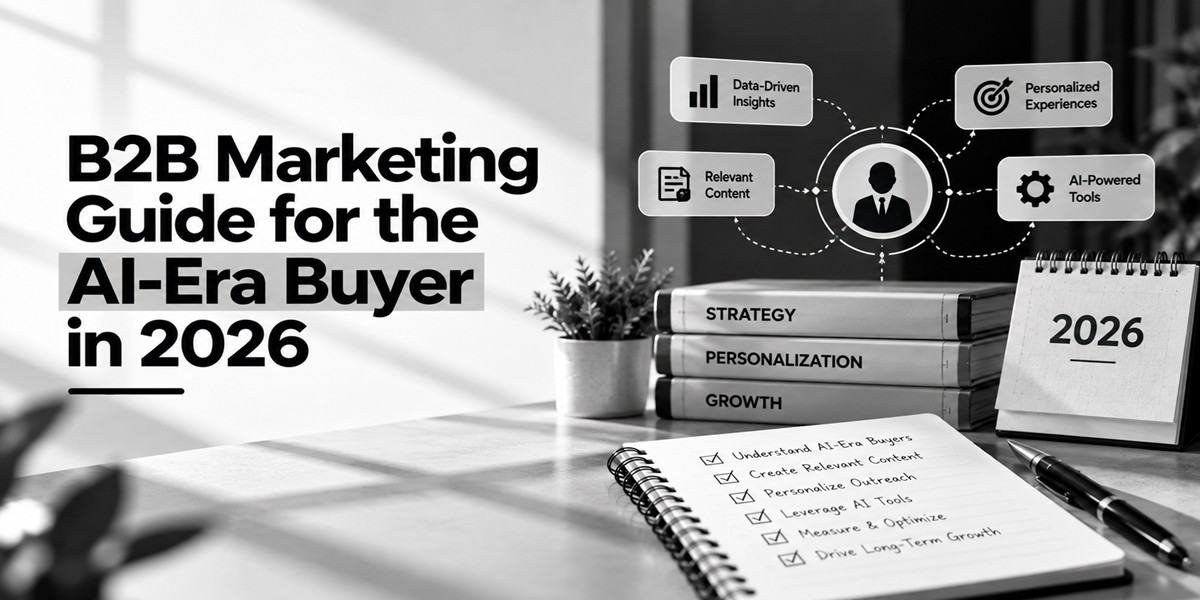

B2B marketing in 2026 is the work of getting your company onto a buyer’s shortlist before they ever talk to sales, and more of that shortlist now forms inside AI answers. If ChatGPT, Gemini or Google’s AI Overviews can’t explain what you do and who trusts you, you start most deals from behind.
In this guide you’ll learn how the B2B buyer journey changed, how SEO, AEO and GEO differ, a six-step strategy, how to check whether AI platforms mention your brand, how to measure results as clicks fall, and which shortcuts Google warns against.
What is B2B Marketing in 2026, and What Changed?
B2B marketing is how one business earns the attention, trust and budget of another. What changed by 2026 is where that trust forms. Buyers now research through AI assistants, peers and trials, and they rank vendors before contacting sales. Your marketing has to work in places you do not control.
The fundamentals still hold. You need a sharp ideal customer profile, a clear offer and proof. Most lists of B2B marketing trends skip the real shift, which is how buyers now gather that proof:
- Buyers want less seller contact. A Gartner survey of 646 B2B buyers found that 67% prefer a rep-free experience, and 45% said they used AI during a recent purchase.
- Outreach volume backfires. In an earlier Gartner survey, 73% of buyers said they actively avoid suppliers who send irrelevant outreach.
- Decisions involve more people. Forrester’s State of Business Buying 2026 reports that a typical purchase involves 13 internal stakeholders and nine external influencers.
So the job is less about louder campaigns. It’s about being the obvious, verifiable answer wherever those 22 people look.
How Does the AI-Era B2B Buyer Journey Work?
Many B2B buyers now start research in a generative AI tool, check what it says against peers and reviews, build a shortlist, then contact sellers after ranking favorites. 6sense found 94% of buying groups ranked preferred vendors before first contact, so the decisive work happens before your sales team knows the deal exists.
This is where AI in B2B marketing matters most. Not in how you write emails, but in how buyers find and judge you. The journey runs in four stages.
1. Framing the problem in an AI chat
A buyer types a full question, such as “how do mid-size SaaS companies cut SOC 2 audit prep time?” The answer names approaches, categories and often vendors. Forrester notes these answer engines are fast but often deliver incomplete or unreliable information, which is why the next stage exists.
2. Validating with the buying network
Buyers check AI claims against colleagues, peers, analysts, review sites and creators they trust. Your brand needs to show up consistently in those places, not only on your own site.
3. Ranking the shortlist
6sense’s 2025 study of more than 4,000 buyers found that 94% of buying groups ranked preferred vendors before first contact. By the time a demo request arrives, you’re usually confirming a preference, not creating one.
4. Proving value in a trial
Forrester found that more than 60% of business buyers now use a trial to reduce risk. Clear pricing logic, security documentation and onboarding guides do real selling here.
Hypothetical example (illustrative, not a client case): A RevOps lead asks Perplexity for “the best pipeline forecasting tools for mid-market SaaS.” The answer names five vendors and cites a review page, two comparison articles and a Reddit thread. A sixth vendor with a better product never appears, because no trusted source describes it. It lost on visibility, not features.
How Do You Build a B2B Marketing Strategy for AI Search?
Start with the questions your buyers ask, publish the most useful answers on your own site, earn genuine mentions on sites buyers and AI tools already trust, keep facts consistent everywhere, and measure monthly. It’s classic B2B marketing with one change: you plan for the AI answer as well as the click.
- Map buyer questions by role. Interview five recent customers and three lost deals. Pull questions from sales calls and support tickets. Group them by role: economic buyer, technical evaluator, end user and procurement.
- Benchmark what AI says today. Run the audit in the next section before you publish anything. It shows where you’re missing and which sources AI already trusts.
- Build a B2B content marketing strategy around non-commodity answers. Google’s AI optimization guide favors first-hand experience over common-knowledge lists. “10 benefits of a CRM” is commodity content. “What broke in our 40,000-contact CRM migration” is not.
- Earn genuine third-party mentions. Publish original data, offer expert commentary to journalists, join niche podcasts, keep review profiles current and contribute bylined thought leadership to credible B2B publications. Paid features are fine when clearly labeled as sponsored.
- Keep your facts consistent. Use the same company description, category, pricing model and leadership names on your site, LinkedIn, review sites and press materials. Contradictions surface as vague or wrong AI answers.
- Hand the same answers to sales. If buyers arrive with an AI-sourced view, sellers need short, specific responses to the questions it raises.
What budget and timeline should you expect?
No reliable public benchmark ties AI visibility to a budget, so treat these as working estimates, not promises:
- Weeks 1 to 4: baseline audit, fixes to inconsistent facts, technical checks. Mostly team time.
- Months 2 to 4: one or two deep, original pieces a month plus a steady flow of earned mentions. Early movement usually shows on niche, long-tail prompts first.
- Months 6 to 12: category-level visibility, which compounds only if you keep going.
On budget, shifting spend usually beats adding it: fewer, deeper assets and more distribution. [Add real B2B Mention campaign result: timeline, starting and ending mention share, budget range.]
How Can You Check If AI Platforms Mention Your Brand?
Run a fixed set of buyer-style prompts through ChatGPT, Gemini, Perplexity, Claude and Google AI Mode each month, then record whether your brand appears, how it’s described, which competitors appear and which sources are cited. Tools such as Ahrefs Brand Radar can automate this at scale.
- Write 20 to 30 prompts in four groups: category (“best SOC 2 automation tools for startups”), problem (“how to cut audit prep time”), comparison (“[your brand] vs [competitor]”) and brand (“what does [your brand] cost?”).
- Run them cleanly. Use a fresh chat with memory off, note the date and location, and run each prompt two or three times, since answers vary between runs.
- Log five things: whether you appear, where in the answer, how you’re described, which competitors appear and which URLs are cited.
- Act on the gaps. Wrong facts mean updating your pages and profiles. Missing mentions mean studying the cited sources, because those are the sites your outreach should target.
Five starter prompts for a SaaS brand:
- “What are the best [category] tools for a [company size] [industry] company?”
- “What do users complain about with [your brand]?”
- “[Your brand] vs [top competitor]: which is better for [use case]?”
- “Is [your brand] SOC 2 compliant, and what does it cost?”
- “Which [category] vendors do analysts recommend in 2026?”
A manual audit is a sample, not a census. Answers shift with personalization and model updates, so watch the monthly trend.
How Do You Measure B2B Marketing Results When Clicks Are Falling?
Measure visibility, influence and revenue together. Track AI Overview and AI Mode performance in Search Console, mention share from your prompt audit, branded search demand, self-reported attribution on demo forms and pipeline from engaged accounts. Clicks alone understate impact because AI answers satisfy many searches without a visit.
Pew Research analyzed browsing data from 900 US adults and found people clicked a traditional result in 8% of visits when an AI summary appeared, against 15% when none did. Links inside the summary were clicked in just 1% of visits. Judge content by sessions alone and you’ll undervalue it.
Track AI search visibility in five layers:
- AI visibility in Google: the Generative AI performance report in Search Console, which Google points to in its AI optimization guide. Review monthly.
- Mention share: the percentage of audit prompts where you appear. Monthly.
- Demand: branded search volume. Monthly.
- Influence: a free-text “How did you hear about us?” field on demo forms. Count the answers that name AI tools.
- Revenue: pipeline and win rate from accounts that engaged with your content. Quarterly.
What Should B2B Marketers Do Next?
B2B marketing in 2026 rewards the brands that buyers and AI tools can verify. Start this week: run the 20-prompt audit, note where you’re missing, and list the three sources AI cites most in your category. Those three sites are your first outreach targets.
If you want help earning genuine, clearly labeled visibility, see pitch an original, data-backed piece through Write For Us
FAQs:
Is SEO still worth it for B2B companies in 2026?
Yes. Google says its AI Overviews and AI Mode are built on its core ranking systems, so a page must be indexed and eligible for a snippet before it can appear in AI answers. Strong SEO is the entry ticket for AI visibility, not a separate channel you can skip.
Do backlinks still matter for AI search?
Yes, but less than many teams assume. In Ahrefs’ 75,000-brand study, backlink count correlated with AI Overview brand visibility at 0.218, well below branded web mentions at 0.664. Links still help pages get discovered and ranked, which AI features rely on, so treat them as support, not the strategy.
Can I pay to get my brand mentioned in ChatGPT?
Nobody can legitimately guarantee that ChatGPT or any AI model will mention your brand in its answers. You can pay for clearly labeled sponsored content on real publications, but Google warns that inauthentic mentions don’t help, and its spam policies cover its own AI responses. Treat guarantees as a red flag.
How long does it take to show up in AI answers?
Expect weeks for factual fixes and two to four months for new content and mentions to change answers on niche prompts, based on working estimates rather than a published benchmark. Broad category prompts take longer. Track monthly so you can see the direction before results are obvious.
Should B2B companies still gate their content?
Gate less than you used to. Gartner found 67% of B2B buyers prefer a rep-free experience, and AI crawlers generally can’t read or cite content hidden behind forms. Keep pricing logic, documentation and comparisons open, and reserve gates for genuinely high-value assets such as original research or tools.
How do I see traffic from Google AI Overviews?
Use Google Search Console. Clicks and impressions from AI Overviews and AI Mode count toward your Performance report totals, and Google’s Generative AI performance report shows how content performs in its AI features. For ChatGPT, Perplexity and other assistants, check referral traffic in your analytics instead.