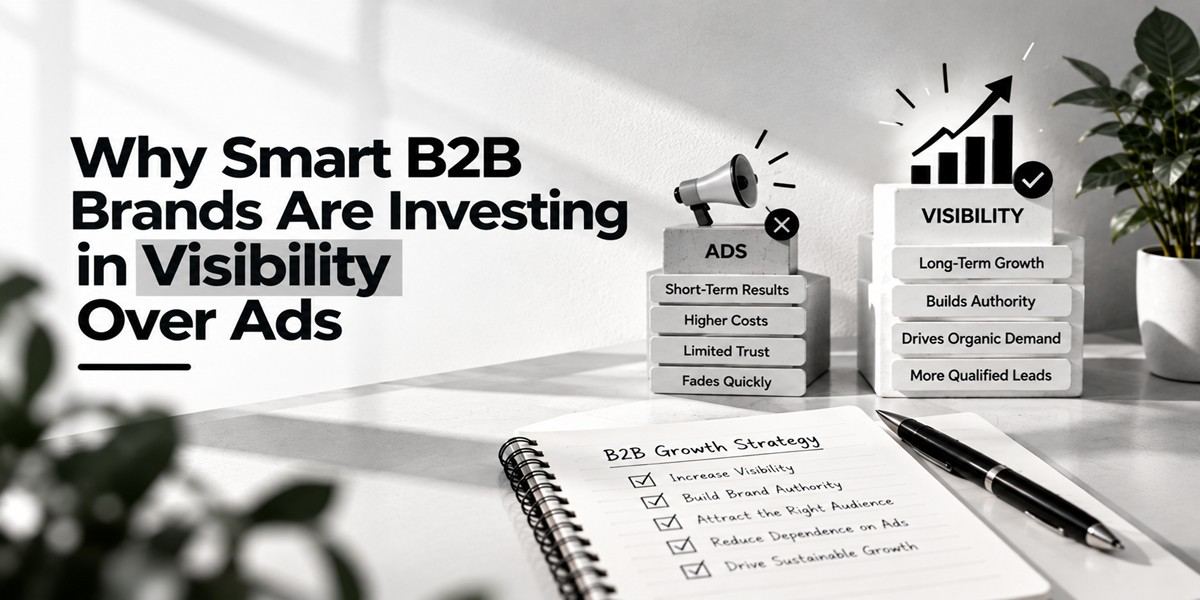

Smart B2B brands are moving budget from ads to visibility because buyers now pick their vendor before any sales conversation begins. LinkedIn and Bain found that 81% of buying groups already knew the winning product on day one, and Ahrefs data shows that brand mentions predict presence in AI search better than backlinks do. Ads rent attention. Visibility keeps it.
I have sat in enough budget reviews to know how this conversation usually goes. The CFO asks why paid search costs 13% more than last year. Marketing explains that the auction got more crowded. Everyone agrees to “optimize harder,” and the same meeting happens again next quarter.
The brands that have stopped having that meeting did something different. They treated B2B brand visibility as an asset to build, not a line item to rent. This article explains why that shift is happening, what the data says, and how to make the move without blowing up your pipeline.
Key Takeaways:
- 81% of B2B buying groups already knew the product they eventually bought on day one of the purchase process, according to LinkedIn’s B2B Institute and Bain & Company.
- Average Google Ads cost per click rose to $5.26 in 2025, up 12.88% in one year, with costs rising in 87% of industries (WordStream).
- Branded web mentions show a 0.664 correlation with brand visibility in Google AI Overviews, the strongest of any factor Ahrefs measured across 75,000 brands.
What does B2B brand visibility actually mean today?
B2B brand visibility is the degree to which buyers, search engines, and AI assistants recognize your company as a credible option before anyone on your team gets involved. It is not the same as traffic, and it is definitely not the same as impressions.
Ten years ago, online brand visibility meant ranking on page one for a handful of keywords. Today it has three layers. The first is organic search visibility: showing up for the questions your buyers type into Google. The second is third-party brand mentions: being named in industry publications, comparison sites, analyst notes, podcasts, and community threads. The third is AI search visibility: being cited when a buyer asks ChatGPT, Perplexity, or Google’s AI Overviews which vendors to consider.
The first layer is where most B2B digital marketing strategy still stops. The second and third are where the advantage now sits, because those are the layers an ad budget cannot buy.
Why are paid ads delivering less for B2B brands than they used to?
Paid ads cost more every year and the extra spend buys the same clicks, not better buyers. WordStream’s analysis of more than 16,000 Google Ads campaigns found the average cost per click climbed from $4.66 in 2024 to $5.26 in 2025, a 12.88% jump, with costs rising in 87% of industries. That is the fifth straight year of increases.
Here is the mini-case I use with clients. Picture a mid-market SaaS vendor spending $20,000 a month on search ads at last year’s rates. At this year’s rates, the identical click volume costs roughly $22,600. Nothing improved. The brand simply paid $31,000 more over twelve months to stand still.
The quieter problem is what happens when the budget pauses. A separate WordStream review of 15,000 accounts found nearly 29% recorded zero conversions across a 90-day window. Ads are a tap. The moment you turn it off, the flow stops, and nothing you spent last year helps you this year. That is the core weakness in the paid ads vs. organic marketing debate, and it is why the smart money is moving.
How does organic marketing compound where ads cannot?
Organic marketing for B2B compounds because every asset you publish keeps working after you stop paying for it. A guide that ranks today still ranks next quarter. A podcast appearance still gets found two years later. An ad impression is gone the second it loads.
The compounding shows up in three places. First, each new piece of content strengthens the pages around it, so the cost of ranking the next page falls. Second, every third-party mention raises the odds of the next one, because editors and analysts cite brands they already see cited elsewhere. Third, branded search grows, which lowers the cost of whatever paid search you still run.
This is why organic growth strategies for B2B look slow for the first six months and then look unfair. The curve bends. Ads never bend; they just get steeper. If you want examples of brands that built this way, our roundup of 25 B2B marketing examples from SaaS and enterprise brands shows what the compounding looks like in practice.
Why does being mentioned now beat being linked?
Brand mentions have overtaken backlinks as the strongest signal of visibility in AI-driven search. Ahrefs studied 75,000 brands and found that branded web mentions, linked or unlinked, showed a 0.664 correlation with appearing in Google AI Overviews. Link-based metrics scored far lower, with one key link factor at just 0.274. Brands earning the most web mentions appeared up to ten times more often in AI Overviews.
The logic is simple once you see it. Large language models learn from text, and text is full of names, not hyperlinks. When a trade publication writes “vendors like Acme and Beta lead this category,” the model stores that association whether or not a link exists.
For a B2B brand awareness strategy, this changes the goal. You are no longer chasing a domain authority score. You are building a reputation that gets repeated by people who do not work for you. We break down how that works in our guide to B2B brand mentions in the AI SEO era.
How are AI search engines changing who gets found?
AI search collapses the buyer’s shortlist into a single answer, so brands that are not already known get skipped entirely. Gartner predicted that traditional search engine volume would fall 25% by 2026 as buyers shift questions to AI chatbots and assistants. In the same Ahrefs study, 26% of brands had zero mentions in AI Overviews. Those brands do not rank lower. They are absent.
Think about what a buyer actually types. Not “CRM software,” but “which CRM is best for a 40-person services firm with two sales reps?” The assistant answers with three or four names. If your brand has never been described that way anywhere on the web, it cannot be one of them.
This is the part of the shift that paid ads cannot patch. You cannot bid your way into a ChatGPT answer. You earn your way in through consistent, credible mentions. Our piece on how to increase brand mentions and citations in AI search walks through the tactics.
What happens in the 95% of the market that ads never reach?
Most of your market is not buying this quarter, and ads only talk to the small slice that is. The Ehrenberg-Bass Institute’s widely cited 95-5 rule holds that roughly 95% of B2B buyers are out of market at any given moment. Paid search, by design, targets the 5% typing purchase-intent queries right now.
The problem is that the 5% already made up their minds. LinkedIn’s B2B Institute and Bain surveyed more than 500 senior buyers and found 81% said the product they eventually bought was known to everyone in the buying group on day one. Bain’s follow-up research puts the share of buyers who purchase from that day-one list at around 90%.
So the real contest is for a spot on the list, and the list is written during the long stretch when nobody is clicking ads. Visibility is how you show up in that stretch. Ads are how you fight over the leftovers.
Which is the better investment for B2B growth: paid ads or organic visibility?
Paid ads win on speed; organic visibility wins on everything that matters past month six. Neither is useless, but they are not interchangeable, and treating them as equal lines on a budget hides the difference.
Factor | Paid ads | Organic visibility |
Time to first result | Days | 3 to 6 months |
Cost trend | Rising 12.88% YoY (WordStream, 2025) | Flat or falling per asset over time |
Value after spend stops | Zero | Continues for years |
Reach into the 95% out-of-market | Minimal | Primary strength |
Influence on day-one shortlist | Low | High |
Presence in AI answers | Cannot be bought | Earned through mentions |
Trust signal to buyers | Low (labeled as ad) | High (third-party validation) |
Best use | Capturing demand | Creating owning demand |
How do you build visibility that keeps working after the budget stops?
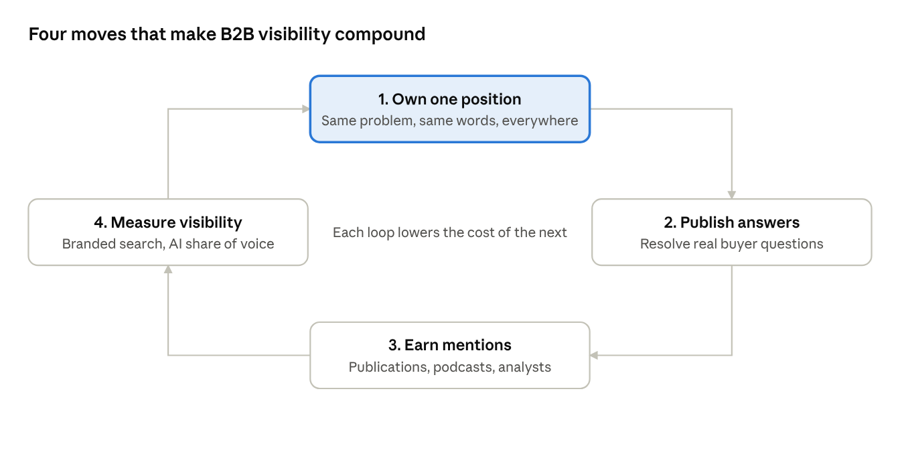
A durable brand visibility strategy runs on four connected moves, and each one feeds the next. Here is the sequence we use with B2B teams.
- Own one clear position. Pick the specific problem you solve for a specific buyer and say it the same way everywhere. AI models and editors can only repeat what is consistent.
- Publish answers, not announcements. Build a library that resolves the exact questions your buyers ask, in the words they use. Our B2B marketing guide for the AI-era buyer covers how buyers research now.
- Earn third-party mentions on purpose. Treat industry publications, comparison sites, podcasts, and analyst roundups as a channel with targets, not a happy accident. Unlinked mentions count.
- Measure what buyers see, not what you ship. Track branded search volume, share of voice in AI answers, and mention velocity month over month.
Run this loop for two quarters and the numbers start to move on their own. That is the moment ads become a choice instead of a dependency.
Conclusion
The case for visibility over ads is not a philosophy. It is arithmetic. Ad costs rise every year, buyers decide before they click, and AI assistants only name brands they have already seen described. The companies pulling ahead are the ones that stopped renting attention and started owning it.
Here is what to do in the next 30 days:
- Pull your last 12 months of paid spend and calculate what the same clicks cost today. Put that number in front of leadership.
- Ask ChatGPT, Perplexity, and Google AI Overviews five buyer-style questions about your category. Note whether you appear.
- Count your third-party brand mentions from the past quarter. If it is under ten, that is your first target.
- Shift 15% to 20% of next quarter’s ad budget into content and mention-building, and hold it there for two quarters before judging.
Two quarters is the honest timeline. The brands that commit to it stop asking why ads cost more every year, because they no longer depend on the answer.