
Why Invented Copy Loses to the Voice of the Customer
Most marketing copy is written from the inside out. A team lists the product’s features and dresses them up in professional-sounding language. The result reads fine, and it reads like every competitor’s page, because everyone is guessing at the same blank wall.
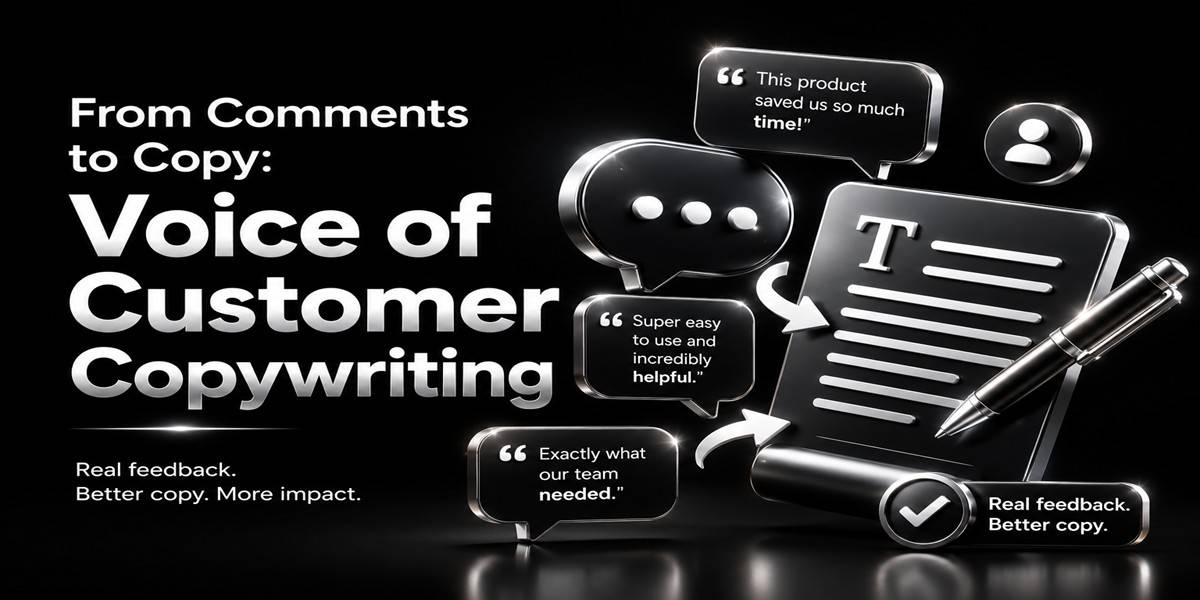
Voice of customer copywriting is the opposite move: instead of inventing words, you mine the language your buyers already use and write your headlines, pages, and ads in those exact words. (Voice of customer, or VOC, is the verbatim phrasing real buyers use to describe their pains, desires, and objections.) The mine-to-copy loop is short and repeatable:
- Mine the language where your buyers talk.
- Extract the verbatim pains, desires, and objections into a swipe file.
- Rewrite your generic claims in their words.
- Test the variants against a control.
- Feed the winners back in, then repeat.
Joanna Wiebe’s team at Copyhackers pioneered the review-mining approach for exactly this reason. The problem is not effort. It is the source. When you invent the words, you describe the product the way you wish people thought about it. Your buyers think about the meeting they sat through, the tool they could not get approved, the vendor that burned them last year. They carry specific words for those frustrations, and those words almost never match the phrases on your landing page.
Copy in the customer’s own language does three things invented copy cannot. It gets recognized faster, because the reader has thought those words before. It builds trust, because it proves you understand the situation, not just the category. And it qualifies, because the right person feels called out while everyone else moves on.
Where to Find Customer Reviews to Mine, and How to Read Each Source
Your buyers are writing your copy for you right now, in public, for free. You just have to know where to look.
Discussion communities are the richest seam. Industry subreddits, Hacker News, niche forums, and Quora are where people complain, compare notes, and ask for help without a salesperson in the room. They are not performing; they are venting or genuinely trying to solve something, which is exactly the unfiltered pain and trade slang you want.
Review sites are the second seam, and the trick is to read them upside down. On G2 and other software review sites, on Trustpilot, and on Product Hunt, do not start with the five-star reviews. Start with the two and three-star ones. The glowing reviews tell you what marketing already knows. The middle reviews carry the real objections: the thing that almost stopped the purchase, the feature that disappointed, the fear that nearly won.
YouTube comments are the third seam, and the most underused. Read the comments under a competitor’s demo or review video. People say things there they would never put in a formal review: direct comparisons, deal-breakers, and the questions your sales team gets every day.
Pick one source today and bookmark three specific places inside it. A short, repeatable list, not the whole internet.
How to Spot a High-Signal Thread
Most threads are noise. You are hunting for the few that carry real signal, and there are four tells.
First, sort by engagement. Comments with the most replies or upvotes have already been validated by the crowd. If a hundred people agreed with a complaint, it is a pattern, not one person’s bad day.
Second, look for emotional spikes. Scan for frustration, relief, and especially the word “finally.” A flat, factual comment rarely makes good copy. A furious or relieved one almost always does, because emotion is what makes a hook stop the scroll.
Third, prioritize specificity. “It’s expensive” is weak. “Took months to approve a $2k tool” is gold, because the detail is the proof you can lift straight into a headline.
Fourth, flag repetition across unrelated threads. When the same gripe shows up in a subreddit, a review, and a YouTube comment from three strangers, you have found a core objection, not an outlier. Treat review mining as audience research, not proof, and do not draw a firm conclusion from one or two data points.
Extracting the Verbatim Language
Reading is not extracting. If you paraphrase what you remember, you have thrown away the only thing that made the thread valuable: the exact words. Capture language verbatim, before your inner marketer “cleans it up.”
Sort everything into three buckets. A pain is the problem they live with. A desire is the outcome they want. An objection is the reason they hesitate. Almost every useful line falls into one of these three.
Build a three-column swipe file with those headers: Pain, Desire, Objection. For every line, record the raw quote, word for word, and where you found it. The source matters, because a quote from r/sysadmin lands differently than one from a consumer review. This message-mining guide and template is a useful hands-on companion.
Here is what real capture looks like. Under Pain, a comment from r/sysadmin: “I’m in the private sector at a fortune 50 company it takes 9 to 12 months to onboard something new.” Under Objection, from the same kind of buyer: “took months to approve a $2k tool, could have bought it myself.” Do not fix the grammar or smooth it out. The imperfection is the proof that a human wrote it.
From Verbatim to Message
This is where the work pays off. You turn raw quotes into copy that converts, without sanding off what made them powerful. Take a generic claim and rewrite it in the customer’s language. Two examples:
Example A, problem-aware (B2B software):
Before (generic): “Streamline your software procurement and accelerate time to value.”
After (customer language): “Your team found the tool in March. Procurement will approve it by Christmas. Here is how to stop losing nine months to a signature.”
Why it works: The before line is a category description any vendor could run. The after line is built from a real pain quote, a comment in r/sysadmin: “I’m in the private sector at a fortune 50 company it takes 9 to 12 months to onboard something new.” It dramatizes the nine months the buyer actually lives through. A procurement-burned manager reads it and thinks “that is exactly my life,” a reaction no polished category language can buy.
Example B, objection-led (B2B SaaS):
Before (generic): “Trusted by thousands of growing companies.”
After (customer language): “You don’t want to build your stack on a vendor that 10x’s the price in six months. Neither do we. Here is our pricing, locked, in writing.”
Why it works: The before line is generic reassurance the reader skims past. The after line is built directly from a stated objection, a comment in r/SaaS: “you rely on a service that you don’t know if it’s still there in 6 months or decide to 10x their price (it happened this to me) with Usersnap in the past.” Instead of ignoring the fear, the copy names it out loud and answers it. Naming the objection before the buyer does is the fastest way to earn trust.
Turning One Insight Into a Set of Angles
A single strong quote is not one headline. It is five. Take one objection and work it four ways. State it: say the fear plainly, the way the buyer feels it. Reverse it: flip the fear into the promise, so the worst case becomes the guarantee. Preempt it: raise the objection before the reader does and answer it on the spot. Reframe it: change the frame so the objection stops applying.
Use the price-hike objection as the seed. State it: “Tired of vendors that 10x the price the moment you depend on them?” Reverse it: “Lock your price in writing, for as long as you stay.” Reframe it: “Most tools price you for the day you sign. We price you for the years after.”
Desires work the same way: pair the desire with the quote that proves it. If buyers keep saying they want simplicity, anchor the headline to the literal line where someone said it, so the promise comes with built-in evidence.
Testing and Measuring So the Customer Picks the Winner
You do not get to choose the winning angle. Your buyer does. Your job is to put the variants in front of them and read the result honestly.
Run your voice-of-customer variants against a control, usually your current best line or the generic version you would have shipped anyway. Same audience, same placement, only the words change. Change five things at once and you learn nothing. In B2B a voice of customer process has to account for a buying committee: the line that wins the end user can lose the budget holder, so test against the stakeholder you actually need to move.
Watch the metrics that map to each stage. For ads, watch hook retention and scroll-stop rate in the first three seconds, because that is where a hook lives or dies. For pages and emails, watch click-through and reply rate. The earliest metric is the most honest, because it measures whether the words alone earned a second of attention.
Then comes the hard part: let the data overrule your taste. The line you are proudest of will sometimes lose to the blunt one you almost cut. Feed the winners back into the swipe file, marked by audience and metric, so it becomes a record of what actually converts.
Voice of Customer Copywriting: Your Buyers Already Wrote Your Best Copy
The best copy you will write this quarter is already written. It is sitting in a Reddit thread, a three-star review, and a YouTube comment, in your buyer’s own words, waiting for you to pick it up.
Run the same short loop on repeat and every cycle makes your guessing rarer. That is voice of customer copywriting as a habit, not a one-time project. You do not have to run the whole loop today to start. Pick a single objection from a real review, the one that almost stopped a sale, and rewrite one headline around it. Ship it, watch the number, and let your customer tell you if you got it right.
FAQs
What is review mining and how do you use it for copywriting?
Review mining is reading real customer reviews and comments to pull out the exact words buyers use, then writing your copy in those words instead of inventing your own. You sort the quotes into pains, desires, and objections, then rewrite generic claims as headlines built from those real lines.
Where do you find customer reviews to mine for copy?
The richest sources are discussion communities (subreddits, Hacker News, Quora), review sites (G2, Trustpilot, Product Hunt), and YouTube comments under competitor demos. Start with two and three-star reviews, because the middle reviews carry the objections that nearly stopped a purchase.
How do you use voice of customer research to boost conversions?
You run the language you found against a control, changing only the words, then watch the earliest metric for the channel: hook retention for ads, click-through and reply rate for pages and emails. That metric, not your taste, tells you which line actually converts.
How do you gather voice of customer data for B2B companies?
Mine the places B2B buyers speak candidly, subreddits like r/sysadmin and r/SaaS, software review sites, and competitor video comments, and tag every quote by source. Because B2B purchases run through a buying committee, Gartner’s research on B2B voice of customer data shows why you should capture language from each role: end user, manager, and budget holder.
Adlicio, a voice-of-customer mining tool, mines real customer comments from Reddit, YouTube, and review sites into ad angles and hooks for ecommerce and B2B teams. Daniel runs it.
Author:
Daniel (Guest Author)
Daniel runs Adlicio (http://tryadlicio.com), which mines real customer comments from Reddit, YouTube, and review sites into ad angles and hooks for ecommerce and B2B teams.