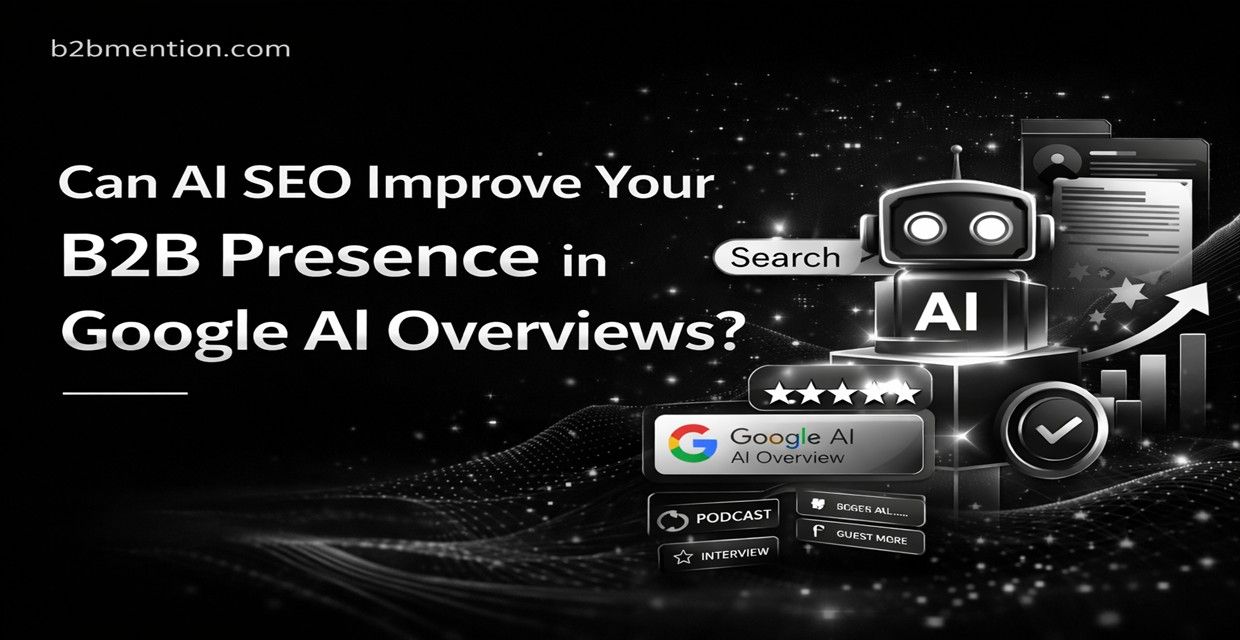

Yes, AI SEO can significantly improve your B2B presence in Google AI Overviews by increasing your chances of being cited, summarized, and recommended in AI-generated search results. Businesses that create authoritative, well-structured, entity-rich content are more likely to appear in AI Overviews, helping them gain visibility even when traditional organic rankings fluctuate.
Search is no longer a list of blue links. It is an answer engine. Google’s AI Overviews (AIOs) now synthesize content from multiple authoritative sources and deliver a single, structured response directly on the SERP, before a user ever clicks a result. For B2B brands, this shift is not gradual; it is seismic.
In the rapidly evolving landscape of search, the traditional SEO playbook is being rewritten. As of April 2026, 64.82% of Google searches end without a single click (Source).
For B2B organizations, this “zero-click” reality is no longer a threat, it is the new baseline. The emergence of Google AI Overviews (AIO) and the more interactive AI Mode has shifted the focus from ranking pages to becoming the definitive answer.
This shift is known as Answer Engine Optimization (AEO). For B2B brands, the question is no longer just Can AI SEO improve presence in Google AI Overviews? but How can we dominate the AI-driven search funnel to capture high-intent leads?
The New B2B Search Reality: Stats You Need to Know
The impact of AI on B2B search is profound. Recent data highlights a significant divergence between traditional organic results and AI-generated summaries:
Why AI SEO (AEO) is the Ultimate B2B Growth Lever
Traditional SEO focuses on keywords and backlinks to rank a URL. AI SEO (AEO) focuses on entities, structured data, and answer-first content to be selected as the primary source for an AI summary.
1. The 23x Conversion Gap
While AI Overviews may reduce overall traffic volume, the quality of the remaining traffic is unprecedented. B2B buyers who click through from an AI citation have already been “pre-vetted” by the AI’s summary. According to Discovered Labs, these AI-sourced leads convert at a rate 23 times higher than traditional search leads.
2. Breaking the “Top 10” Monopoly
Historically, if you weren’t in the top 3 organic results, you didn’t exist. In the AI era, 62% of AI Overview citations come from pages outside the top 10. This allows specialized B2B firms to leapfrog established incumbents by providing more precise, verifiable answers to complex queries.
3. Dominating Long-Tail B2B Intent
AI Overviews appear in over 61.9% of long-tail B2B queries (7+ words). These are the high-intent searches, like “ERP implementation steps for mid-sized manufacturing firms”, where decision-makers are looking for specific execution details rather than generic definitions.
The 8-Pillar AEO Strategy for B2B Google AI Overview Visibility
Pillar 1: Answer-First Content Architecture
AIOs average 157 words, meaning they pull from content that is extractable, concise, and direct. Every key page on your B2B site should lead with a 50–70 word TL;DR that directly answers the primary query.
Structure each piece around the pattern: Direct Answer → Supporting Evidence → Context → Expert Insight. Avoid preamble. AI systems penalize content that buries the answer.
Queries with eight or more words are 7x more likely to trigger an AI Overview (Single Grain, 2026). Map your B2B content to these long-tail, multi-word queries, think “how to evaluate enterprise CRM vendors for mid-market SaaS” rather than “CRM comparison.”
Pillar 2: Schema Markup – The Technical Foundation
Structured data is non-negotiable for AIO inclusion. Pages with FAQ schema are 60% more likely to be featured in AI Overviews compared to those without structured data (Snezzi.com, 2026). Sites with any structured data see up to a 30% higher visibility rate in AIOs (Averi.ai, 2026).
Implement the following schema types as your B2B AEO baseline:
- FAQPage schema – pre-formats content as Q&A pairs that AI systems extract directly
- Article / BlogPosting schema – signals content type and establishes authorship
- Organization schema – connects your brand entity to the Google Knowledge Graph
- HowTo schema – ideal for process and methodology content common in B2B
- Person schema on author bios – strengthens E-E-A-T signals at the individual contributor level
Validate all schema with Google’s Rich Results Test and the Schema Markup Validator before publishing.
Pillar 3: E-E-A-T Signal Engineering
Experience, Expertise, Authoritativeness, and Trustworthiness (E-E-A-T) are present in 96% of all AIO citations. For B2B brands, this means:
- Byline every piece of content with a credentialed subject matter expert
- Add author schema with LinkedIn URLs, credentials, and publication history
- Cite primary data sources, industry reports, and peer-reviewed research
- Earn mentions in consistently cited publications (Forbes, Gartner, Harvard Business Review, G2)
- Establish an authentic LinkedIn presence – Google AI Overviews and Perplexity both cite LinkedIn as a top source for B2B content
Pillar 4: Topical Authority Cluster Strategy
AI systems favor brands that own complete topic ecosystems, not individual pages. Build pillar-and-cluster content architecture around your core B2B solution areas. Each cluster should have one authoritative pillar page (2,000–4,000 words) supported by 8–15 cluster pages addressing adjacent subtopics.
Internal linking between cluster pages signals topical completeness, a key semantic completeness factor (r=0.87 correlation with AIO selection). Pages with 15 or more connected entities in Google’s Knowledge Graph receive a 4.8x citation boost.
Pillar 5: Conversational & Long-Tail Query Mapping
Over 65% of searches now end without a click, users get their answer on the SERP (O8 Agency, 2026). But question-based queries trigger AI Overviews 99.2% of the time (Snezzi.com, 2026). For B2B, this means mapping content to the specific questions your buyers ask during discovery, evaluation, and vendor comparison stages.
Conduct People Also Ask (PAA) research for every target keyword cluster. Create dedicated content that answers each PAA variant with a crisp, 50-word direct answer followed by deeper elaboration. This architecture serves both featured snippet and AIO capture simultaneously.
Pillar 6: Multi-Modal Content Integration
Combining text, images, and video increases AIO selection rate by 156% (AI Overview Ranking Factors Study, 2025). For B2B brands, this means:
- Embedding explainer videos with full transcripts on key solution and comparison pages
- Using original data visualizations with descriptive alt text and captions
- Publishing educational YouTube content, YouTube ranks among the top citation sources for Google AI Overviews and Perplexity
- Including comparison tables, process diagrams, and annotated screenshots
Pillar 7: Off-Page Authority – The Citation Economy
AIO citations correlate strongly with traditional domain authority signals. 76% of AI Overview citations come from pages already ranking in the top 10, but critically, 46.5% of cited URLs rank outside the top 50 (Averi.ai, 2026). This means structure and authority can overcome ranking position.
Build your off-page AEO signal stack by:
- Earning editorial backlinks from news outlets, universities, and major publishers
- Publishing original proprietary research (surveys, benchmarks, industry reports) that other publications cite
- Engaging on Quora with detailed expert answers – Quora holds a 4% AIO source share (WordStream, 2025)
- Targeting digital PR in Gartner, Forrester, and G2 reports, primary citation sources for B2B AIOs
Pillar 8: Content Freshness & Continuous Iteration
AI Overview content is dynamic. Google prioritizes recency and factual accuracy, especially for B2B technology queries where products, pricing, and capabilities change frequently. Implement a quarterly content audit cadence:
- Update statistics, examples, and product details every 90 days
- Monitor AIO appearances via Google Search Console (AIO data available since June 2025 under the ‘Web’ filter)
- Track citation frequency using tools like SerpApi, Semrush, or BrightEdge
- Identify which competitor pages are being cited for your target queries and conduct gap analysis
Conclusion:
The rise of Google AI Overviews isn’t the end of B2B SEO; it’s the beginning of a more efficient, high-conversion era. By shifting from a “traffic-first” to an “answer-first” strategy, B2B brands can bypass traditional ranking hurdles and secure a direct line to decision-makers.
FAQs
What is the difference between AI SEO and traditional SEO for B2B?
Traditional SEO for B2B focuses on achieving high organic rankings to drive website traffic through keyword optimization, link building, and technical site performance. AI SEO, specifically Answer Engine Optimization (AEO), extends this by structuring content for extraction and citation by AI-powered answer engines like Google AI Overviews, ChatGPT, and Perplexity. Where traditional SEO measures success in rankings and clicks, AEO measures success in citation frequency, brand mentions inside AI-generated answers, and AI visibility scores. For B2B companies, both are essential: traditional SEO builds the authority infrastructure that AEO leverages for AI citation.
Does ranking #1 on Google guarantee inclusion in AI Overviews?
Ranking first on Google increases but does not guarantee AI Overview inclusion. Data shows that if your website ranks first on the SERP, there is a 33.07% chance it will also appear in an AI Overview, and pages at position one have a 58% chance of being cited by ChatGPT (Position Digital, 2026). However, 46.5% of URLs cited in Google AI Overviews rank outside the top 50 organic results (Averi.ai, 2026), meaning that content structure, E-E-A-T authority, schema markup, and semantic completeness can override ranking position for AIO citation. For B2B brands with strong subject matter expertise but lower domain authority, this represents a significant opportunity: optimize for citation-worthiness, not just rankings.