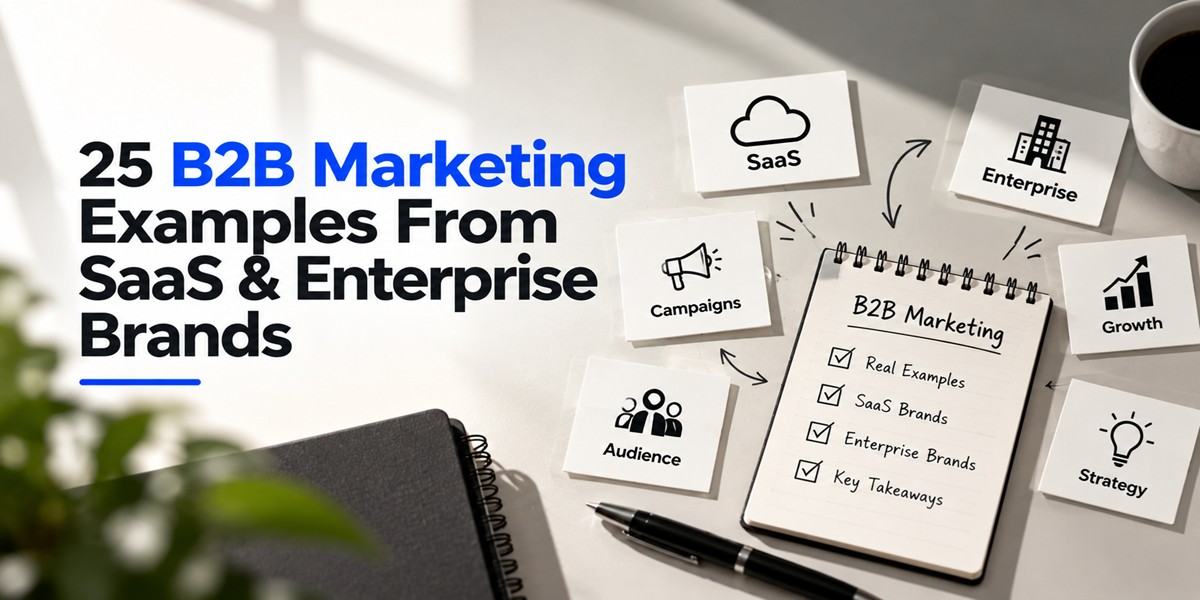

The best B2B marketing examples share one trait: they earn attention from buyers long before those buyers are ready to talk to sales. HubSpot did it with free education, Slack with humour, Zapier with search, and Gong with data nobody else had. This guide breaks down 25 B2B marketing examples from successful brands across SaaS and enterprise, then goes further than the usual list. You will get a repeatable process for applying them, a measurement framework, a way to check whether AI platforms mention your brand, realistic budgets and timelines, and the mistakes that quietly waste money.
What are the best B2B marketing examples from SaaS and enterprise brands?
The strongest examples come from brands that treat marketing as a product in its own right: HubSpot’s free academy, Zendesk’s CX Trends report, Dropbox’s referral loop, Gong’s call data, and Mailchimp’s playful brand work. Below are 25 B2B marketing campaign examples, grouped by the tactic they prove, each with the lesson a smaller team can borrow.
Content, SEO and thought leadership
- Named inbound marketing as a category, then gave away the education (HubSpot Academy, a free CRM) so the brand became the default answer. Lesson: own the vocabulary your buyers use.
- Its annual CX Trends report turns customer data into a recurring press, sales and SEO asset. Lesson: one original dataset beats twenty opinion posts.
- Publishes patterns from recorded sales calls, so every post reads as research rather than advice. Lesson: proprietary data is the hardest thing for rivals to copy.
- Programmatic pages for every app-to-app integration capture long-tail intent at a scale no editorial team could match. Lesson: if your product has a combinatorial structure, your site can too.
- Free courses and certifications pull practitioners into the ecosystem before any purchase. Lesson: certifications create advocates with a reason to say your name.
- “One, Ten, One Hundred” is a documentary series about video budgets that proved a B2B brand can hold attention for half an hour. Lesson: depth is a differentiator when everyone else is skimmable.
- A YouTube channel and free tools that teach SEO using the product as the classroom. Lesson: teach with the product, not about it.
Product-led growth and onboarding
- A two-sided referral programme rewarded both the sender and the recipient with storage, so every user became a channel. Lesson: reward the referee too.
- Every meeting link sent is a live product demo; distribution is built into the core workflow. Lesson: look for the moment your product is seen by a non-user.
- Freemium plus a deliberately funny launch video (“So Yeah, We Tried Slack”) made enterprise software feel human. Lesson: tone is a positioning choice.
- A template gallery and creator community turned users into the marketing department. Lesson: give people something to publish about you.
- Replaced gated PDFs with interactive product demos as the primary conversion asset. Lesson: show, then ask for the email.
- A public community file library where designers share work built in the tool. Lesson: user output is social proof at scale.
Brand and creative campaigns
- Mailchimp, “Did You Mean Mailchimp?” Embraced its mispronounced name with MailShrimp, KaleLimp and friends. Lesson: a weakness owned publicly becomes memorable.
- Mailchimp, “Second Act.” A documentary series with VICE about entrepreneurs starting over, aimed squarely at the brand’s small-business base. Lesson: serve the audience’s identity, not your feature list.
- com. Out-of-home and consumer-style TV aimed at individual users rather than IT buyers. Lesson: in bottom-up software, the user is the buyer.
- Gong, Super Bowl. A revenue-software brand bought a Super Bowl spot to compress years of awareness into one night. Lesson: brand reach is a budget decision, not a category rule.
- Creator-style TikTok skits about office life made a project management tool bingeable. Lesson: entertainment is a distribution strategy.
- Salesforce, “Trailblazers.” Customers are the heroes of every story, backed by a certification path. Lesson: celebrate customers in a way that is also a career asset for them.
Account based marketing examples and personalization
- A programmatic campaign where creative changed with viewer behaviour, used to prove its own advertising technology. Lesson: use your product to run the campaign.
- LinkedIn ABM creative that inserted the target account’s name and logo into the ad. Lesson: personalization at the account level, not just the persona level.
- Competitive displacement campaigns aimed directly at rivals’ customers. Lesson: sometimes the in-market buyer is already someone else’s customer.
- Expansion campaigns triggered by product usage, targeting existing accounts. Lesson: your cheapest pipeline is already paying you.
Community, partnership and ecosystem
- A community forum and marketplace so large that partners and users do much of the selling. Lesson: build the place where your category talks.
- Ecosystem marketing (Data Cloud, partner-led summits) sells the network rather than the database. Lesson: enterprise marketing examples increasingly sell a system, not a product.
What do the best B2B marketing campaigns have in common?
They reach buyers who are not yet in-market, give something useful before asking for anything, and connect brand work to a measurable commercial outcome. Most also use the brand’s own data or product as the raw material, which makes the content hard to copy and easy to recognise.
The timing point matters more than it looks. A March 2026 Gartner survey of 646 B2B buyers found that 67% prefer a rep-free experience and 45% used AI during a recent purchase (Gartner, 2026). 6sense’s 2025 Buyer Experience Report, based on more than 4,000 buyers, found that 94% of buying groups had already ranked their preferred vendors before first contact, and that first contact now happens about 61% of the way through the journey (6sense via Business Wire, 2025).
That is why the LinkedIn B2B Institute’s 95:5 rule, published with the Ehrenberg-Bass Institute in 2021, keeps coming up: at any moment roughly 5% of your buyers are in-market and 95% are not (Marketing Week, 2021). Look back at the list. HubSpot Academy, Zendesk’s report, Wistia’s series and ClickUp’s skits are all 95% plays. Klue and Gainsight are 5% plays. The best programmes run both, and know which is which.
How do you turn these B2B marketing examples into a step-by-step process?
Pick one buying job, choose one tactic from the list that fits the data or product you already have, ship a minimum version in 30 days, measure for 90, then decide whether to scale. Copying the famous version first, at the famous budget, is the most common way these examples fail inside smaller teams.
Here is the workflow we use when planning B2B marketing campaigns:
- Name the buying job. Gartner describes six: problem identification, solution exploration, requirements building, supplier selection, validation and consensus. Each example above serves one or two. Pick yours before picking a tactic.
- Audit your raw material. Proprietary data, a product moment that non-users see, a vocal founder, a customer base with a shared identity. The brands above started from what they had, not from a blank brief.
- Choose one tactic type, not three. Content and SEO, product-led, brand, ABM or community.
- Write the success metric before launch, including the date you will judge it.
- Ship the minimum version. One report, not a research program. One template library, not a community platform.
- Plan distribution in four lanes: owned (site, email), earned (press, mentions), paid (ads), and placed (sponsored articles or brand-mention placements, which we cover below).
- Review at day 90, then scale, fix or stop.
How do you measure results from B2B marketing campaigns?
Track three layers. Leading indicators inside 30 days (reach, engagement, branded search, mentions). Pipeline indicators by 90 days (qualified pipeline, demo requests, self-reported attribution). Revenue indicators at 6 to 12 months (closed-won, deal size, cycle length). Judge brand and content work on the first two layers before expecting the third.
Two practical additions. First, add a free-text “How did you hear about us?” field to every demo and signup form. It catches podcasts, newsletters, AI assistants and word of mouth that click-based attribution misses. Second, build a GA4 segment for AI referrals (ChatGPT, Perplexity, Gemini, Copilot) and watch conversion rate rather than volume; Semrush’s 2025 study found the average AI search visitor converts at 4.4 times the rate of a traditional organic visitor (Semrush, 2025).
Measurement discipline is where most teams fall down. Content Marketing Institute’s 2026 B2B research found that nine in ten marketers already use AI to produce content, yet fewer than four in ten say it has improved performance (CMI, 2025). More output is not the same as more result.
What are the most common B2B marketing mistakes to avoid?
The recurring mistakes are copying a famous campaign without the data or product that made it work, judging brand activity on a two-week window, gating everything, letting thought leadership come from the content team alone, and scaling AI-written volume that adds nothing. Each one is cheap to avoid and expensive to discover late.
- Copying the surface. Gong’s content works because of the call data. A “data-led” post with no data is just a post.
- Short windows on long plays. The 95:5 rule means most effects land months later. Set the review date accordingly.
- Gating by default. Navattic’s shift to ungated demos is the pattern. Gate only what buyers would pay for.
- Thought leadership theatre. CMI found 96% of B2B organisations produce thought leadership, but in many companies fewer than 5% of employees contribute (CMI, 2025). Executives and practitioners need to be on the page.
- AI volume. Google’s spam policies treat scaled content produced primarily to manipulate rankings as abuse, whether a human or a model wrote it. The next section covers what to do instead.
Conclusion
The 25 B2B marketing examples from successful brands above work for the same reasons: they reach buyers before they are in-market, they give before they ask, and they are built on something the brand uniquely owns. Pick one tactic, ship a small version, measure it on the right window, and check whether the sources AI platforms trust are mentioning you.
If they are not, that is the gap B2B Mention exists to close. See our placement and thought leadership services or, if you have a campaign story worth telling, write for us.