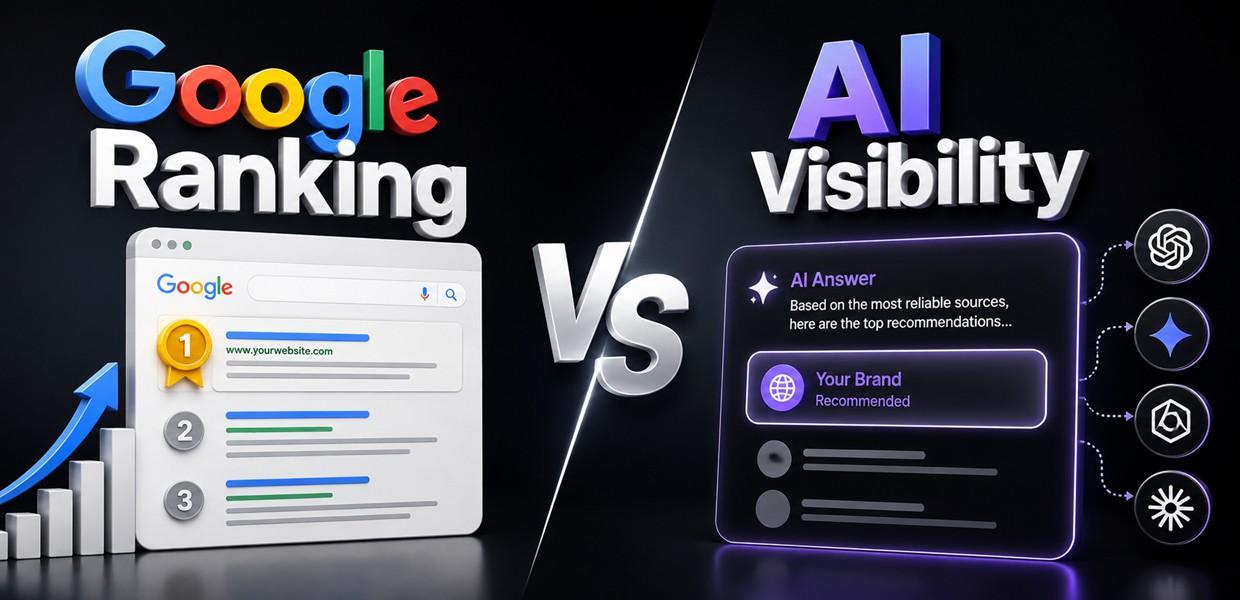

Ranking #1 on Google does not guarantee AI visibility because AI systems select sources on a different logic than the ranking algorithm. Ahrefs’ March 2026 analysis of ~4 million AI Overview URLs found only 38% of cited pages appeared in the first 10 SERP blocks down from 76% in July 2025. Rankings feed AI retrieval; they no longer determine it.
Your SEO dashboard is green. Position 2 for your money keyword. Domain rating in the seventies. Traffic flat but respectable.
Then a prospect on a discovery call says: “I asked ChatGPT who the leaders were in this space and your name didn’t come up.”
That is not a reporting error. It is the single most important structural shift in B2B search since mobile-first indexing — and most marketing leaders are still measuring the wrong system.
Key Takeaways
- Only 38% of URLs cited in Google AI Overviews appear in the top 10 SERP blocks — down from 76% eight months earlier (Ahrefs, March 2026).
- Roughly 31% of AI Overview citations come from pages that don’t rank in the top 100 for that keyword at all (Ahrefs, 2026).
- Only 12% of URLs cited by ChatGPT, Perplexity and Copilot rank in Google’s top 10 (Ahrefs, August 2025).
- Brands cited in AI answers earn 35% more organic clicks and 91% more paid clicks on the same query (Seer Interactive, November 2025).
- Rankings are now an input to AI retrieval, not a guarantee of it. Two systems, two scoreboards.
What Is the Real Gap Between Google Ranking vs AI Visibility?
The gap between google ranking vs AI visibility is selection logic: Google ranks pages, AI systems select sources — and those are two different jobs with two different scoring models.
Classic ranking answers one question: which page best satisfies this query? It is a competition. Ten winners, ranked.
An AI answer engine asks something else entirely. It decomposes your query into sub-questions (query fan-out), retrieves candidate passages for each, then assembles a synthesized answer and attributes the pieces. It is not picking the best page. It is picking the most extractable, most corroborated, most clearly-scoped passage for each fragment of an answer it is already constructing.
That means a page can win the ranking competition and still lose the citation selection — because it buried the answer in paragraph nine, hedged the definition, or never addressed the sub-query the model actually fanned out to. Traditional ranking factors get you into the candidate pool. Content structure, clarity and freshness determine whether you get pulled out of it.
How Much Do Rankings and AI Citations Actually Overlap?
Far less than they did a year ago — and the citation sources overlap is collapsing fast.
Three hard numbers every B2B leader should have in their deck:
- Ahrefs (July 2025) found 76.1% of AI Overview citations came from top-10 ranking URLs. By its March 2026 re-run across 863,000 SERPs and ~4 million AI Overview URLs, that figure had fallen to 37.9%. The remainder split almost evenly between positions 11–100 (31.2%) and outside the top 100 entirely (31.0%).
- Ahrefs (August 2025) found only 12% of URLs cited by ChatGPT, Perplexity and Copilot rank in Google’s top 10 — and roughly 80% of LLM citations don’t rank in Google’s top 100 for the original query.
- Seer Interactive (November 2025) found brands cited in AI Overviews earn 35% higher organic CTR and 91% higher paid CTR than uncited brands on the same SERP.
Read those together and the strategic picture is unambiguous. In eight months, the correlation between ranking and citation halved. Meanwhile the commercial value of being cited went up. You are paying more for a position that buys you less; unless you are also optimizing for selection.
Why Isn’t Your Brand Showing Up in AI Answers Despite Strong Rankings?
Because you optimized a page to win a competition, not to be quoted.
The “why my brand isn’t in AI answers” question almost always resolves to one of five causes, and none of them appear on a rank tracker:
- The answer isn’t extractable. Your definition is spread across three paragraphs with a brand anecdote in the middle. A model needs a self-contained 40–60 word block it can lift cleanly.
- The page is stale. Ahrefs’ 17-million-citation analysis found AI assistants demonstrably prefer fresher content. Freshness is a retrieval filter, not a vanity metric.
- You never covered the sub-query. Fan-out means the model may retrieve for “SOC 2 audit timeline” while you only wrote about “compliance software.” You rank for the parent, and lose the child.
- You have no third-party corroboration. Models cross-check. If your claim exists only on your own domain, it is a single unverified source.
- Wrong format for the intent. Listicles win commercial queries; articles win informational ones. A product page cannot win an “alternatives to X” prompt.
What Do AI Systems Reward That Traditional Search Never Did?
Retrievability — the ease with which a machine can lift a defensible, self-contained claim from your page without needing the rest of it.
Google rewarded relevance and authority at the page level. Answer engines reward clarity and corroboration at the passage level. The unit of competition has shrunk from the URL to the paragraph, and almost no B2B content team has restructured for that.
In practice, this is what answer engine optimization actually means: declarative opening sentences under question-shaped headings, tight factual density, cited primary data, explicit entity naming, and structured content that a parser can segment without guessing. Same page, same topic, same domain authority — completely different citation rate depending on whether the answer sits in sentence one or sentence fourteen.
There is also a corroboration layer that classic SEO ignored. Ahrefs’ study of 75,000 brands found mentions on YouTube titles, transcripts, descriptions were the strongest correlating factor with AI Overview visibility of any signal tested. Your own site is one source. Models want three.
The Dashboard That Lies to You Every Monday Morning
Your rank tracker will keep reporting green while your presence in the answer layer goes to zero — and it will never once warn you.
This is the trap. Every metric on a standard SEO report — position, impressions, DR, referring domains — measures the blue-link system. None of them measure whether an LLM will name you when a CFO asks it to shortlist vendors.
We see the pattern constantly in B2B tech: a company holds positions 1–3 across its core category terms, and is cited in zero of forty tracked buyer-intent prompts. Meanwhile a smaller competitor ranking on page two gets pulled into eight of them, because its content is structured for extraction and its name appears in the roundups, transcripts and forums the models actually retrieve from.
The board sees a healthy SEO report. The pipeline sees a brand that has quietly disappeared from the top of the funnel.
Which Signals Matter Most for Each System?
Match the signal to the system you are trying to win. The SEO vs AEO split is not philosophical — it is operational.
Signal You Should Take | Weight in Google Ranking | Weight in AI Citation | What to Do (Action) |
Backlinks / domain authority | Very high | Moderate (entry ticket) | Maintain — don’t over-invest |
Keyword targeting | High | Low | Shift toward question coverage |
Passage-level clarity | Low | Very high | Answer in sentence one |
Content freshness | Moderate | High | Quarterly refresh cadence |
Third-party mentions | Indirect | Very high | Build editorial presence |
YouTube presence | Low | Very high (Ahrefs) | Publish and transcribe |
Schema / structure | Moderate | High | FAQ, HowTo, Article schema |
Sub-topic coverage depth | Moderate | Very high | Map and cover fan-out queries |
The rows that flip hardest — passage clarity, third-party mentions, YouTube — are precisely the ones absent from most B2B content calendars. That is the gap, expressed as a to-do list.
How Should B2B Teams Measure Both Systems Without Doubling Headcount?
Add one new number to the board deck: citation rate across a fixed prompt set. Everything else follows from it.
A workable measurement layer takes a day to build and ten minutes a week to run:
- Build a fixed set of 40 buyer-intent prompts — the actual questions your ICP asks before a shortlist exists. Not keywords. Questions.
- Run them monthly across Google AI Overviews, ChatGPT, Perplexity and Gemini. Record whether you are named, cited, or absent. That ratio is your AI visibility baseline.
- Segment by funnel stage. Absence at the top of the funnel is a demand problem. Absence on “alternatives to competitor X” is a revenue problem — fix that first.
- Track it beside rankings, never merged into them. A single blended “search score” destroys your ability to see which system is failing.
- Attribute separately. AI-referred visitors convert at roughly 4.4x traditional organic (Semrush, June 2025) — blending them hides your best-converting channel.
If your reporting cannot answer “are we in the answer or not,” you do not have an AI search optimization program. You have a ranking report and a hope.
Conclusion
Google rankings still matter, but they are no longer the full measure of search visibility. A page can dominate the SERPs and remain absent from the AI-generated answers shaping your buyers’ decisions. The winners in 2026 will be brands that optimize for both systems: ranking for discovery and retrievability for citation.
Start by identifying the questions your buyers actually ask, then make your answers clear, current, evidence-backed, and easy for AI systems to extract and verify. Build third-party authority beyond your own website, monitor citation rates alongside rankings, and track where competitors are appearing when you are not.
The goal is no longer simply to reach page one. It is to become one of the trusted sources AI chooses to mention, cite, and recommend. That is the new layer of search visibility B2B brands cannot afford to ignore.
FAQs
Does ranking #1 on Google guarantee an AI Overview citation?
No. Ahrefs’ March 2026 study found only 37.9% of AI Overview citations came from pages in the first 10 SERP blocks, down from 76.1% in July 2025. Ranking first improves your odds — roughly a 33% citation probability — but it is not a guarantee.
Why does my competitor get cited in ChatGPT when I outrank them?
Because LLM retrieval barely tracks Google rankings. Only about 12% of URLs cited by ChatGPT, Perplexity and Copilot rank in Google’s top 10. Citation favors extractable, well-structured passages, fresh content, and brands corroborated across third-party sources — not the highest-ranking page.
Is AEO replacing SEO, or do I need both?
You need both. Traditional ranking still feeds the candidate pool AI systems retrieve from, so SEO remains the entry ticket. Answer engine optimization determines whether you get selected from that pool. They are sequential systems, not competing ones — fund them as parallel workstreams.
How do I check if my brand appears in AI answers?
Build a fixed set of 30–40 buyer-intent questions your ICP actually asks, then run them monthly across Google AI Overviews, ChatGPT, Perplexity and Gemini. Record whether you are cited, mentioned, or absent. That percentage is your baseline AI visibility metric.
What single change most improves AI citation rate?
Restructure your existing top-ranking pages answer-first. Put a self-contained, 40–60 word declarative answer immediately under each question-shaped heading. You already hold the authority; you are simply making the answer liftable. This is the fastest measurable win for most B2B sites.
Does content freshness affect AI visibility?
Yes, meaningfully. Ahrefs’ analysis of 17 million citations across seven AI platforms found assistants systematically prefer fresher content. Establish a quarterly refresh cadence on your highest-value pages — updating substance, not just the date stamp, which models and reviewers both detect.