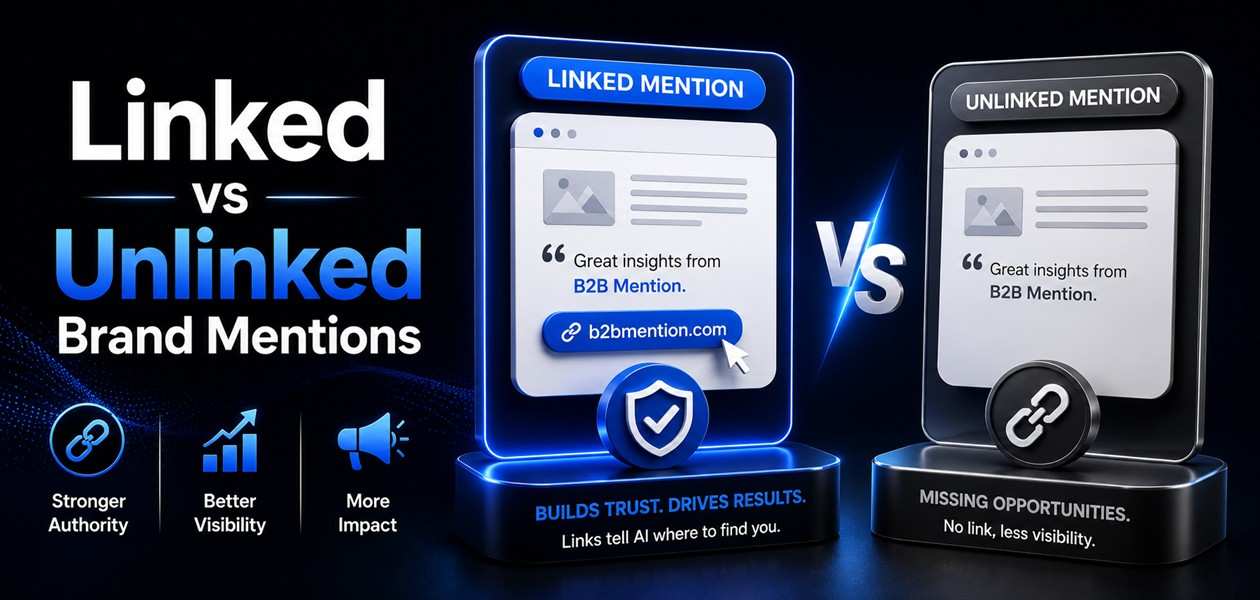

The difference between linked vs unlinked brand mentions is a clickable hyperlink: linked mentions pass authority and referral traffic, while unlinked mentions pass entity signals and trust. Linked mentions still win for classic rankings, but unlinked mentions now win for AI visibility — SEMrush data shows 88% of AI Overview citations come from sources that never rank in the top 10.
For fifteen years, B2B marketing leaders have been trained to ask one question when their brand appears in a publication: “Did we get the link?” If yes, celebrate. If no, chase the editor.
That reflex is now costing you pipeline. Search has split into two systems — the blue-link index and the AI answer layer — and each one reads your brand differently. One counts hyperlinks. The other counts how often your name shows up beside the problem you solve.
Here is how to think about both, and where to put your budget.
Key Takeaways
- Linked mentions pass PageRank; unlinked mentions pass entity confidence. You need both, for different reasons.
- SEMrush found 88% of pages cited in Google AI Overviews do not rank in the top 10 organic results — authority alone no longer guarantees citation.
- Google’s own patent (US8682892B1, “Ranking Search Results”) explicitly covers “implied links” — references to a source without a hyperlink.
- A 2024 Ahrefs study of 75,000 brands found brand web mentions correlate with organic traffic at r = 0.664 — stronger than many link metrics.
- The winning play is not choosing one. It is a brand mention strategy that earns the mention first and converts a share of them into links second.
What Is the Real Difference Between Linked vs Unlinked Brand Mentions?
A linked mention names your brand and hyperlinks it to your site. An unlinked brand mention names your brand and stops there. That single anchor tag is the entire mechanical difference — but it splits into two very different value chains.
A linked mention does three jobs: it passes authority through Google’s link graph, it sends referral traffic, and it tells crawlers where your canonical entity lives. It is a vote with a return address.
An unlinked mention does one job extremely well: it builds entity association. When TechCrunch writes “vendors like Acme are solving procurement fraud,” Google’s Knowledge Graph now has one more datapoint tying Acme to procurement fraud — even with no anchor tag anywhere on the page.
The old model treated mentions without a link as failures. The correct model treats them as a different asset class. Backlinks compound authority. Mentions compound recognition. B2B buyers, and increasingly LLMs, run on recognition.
Do Unlinked Mentions Actually Move Rankings and Revenue?
Yes — but indirectly, and the effect is now measurable in AI surfaces before it appears in blue links.
The question “do unlinked mentions help SEO” has a cleaner answer in 2026 than it did in 2020. Three hard data points:
- Ahrefs analyzed 75,000 brands and found a 0.664 correlation between the number of web mentions a brand receives and its organic search traffic — a strong relationship by SEO-study standards.
- Semrush’s AI Overviews study found 88% of cited URLs sit outside the top 10 organic results, meaning Google’s generative layer is selecting sources on relevance and entity fit, not just link equity.
- Google’s “Ranking Search Results” patent (US8682892B1) defines an “implied link” as a reference to a target resource without an actual hyperlink — the mechanism is documented, not speculative.
Mini-case from our own desk: a mid-market cybersecurity client of ours ran a 90-day editorial push with zero link acquisition targets — commentary placements only, links optional. Across 34 placements, 21 were unlinked. Branded search volume rose 41%, and the brand went from being cited in 2 of 40 tracked AI prompts to 14 of 40. Organic non-branded traffic followed 60 days later, up 19%. The links were not the mechanism. The repetition was.
Why Do AI Search Engines Treat Brand Mentions Differently Than Google Did?
Because LLMs do not crawl a link graph — they compress a text corpus.
Classic Google ranking asked: who links to this page, and how authoritative are they? That is a graph problem. An LLM asks a different question at inference time: when people write about this problem, which brand names appear? That is a co-occurrence problem.
A backlink buried in a footer contributes almost nothing to a language model’s statistical understanding of your company. But a sentence that says “Acme, a procurement fraud platform used by mid-market CFOs,” contributes enormously — because it is training-grade context. It defines what you are, who you serve, and what category you own.
This is why brand mentions vs backlinks is no longer an either/or debate for B2B leaders. Backlinks are infrastructure. Mentions are vocabulary. If your brand is not in the vocabulary of your category, an LLM cannot recommend you, no matter how strong your domain rating is.
When Should a B2B Brand Prioritize Linked vs Unlinked Brand Mentions?
Prioritize links when you are fighting for a specific commercial keyword. Prioritize mentions when you are fighting to be considered at all.
The practical split most B2B teams should run:
- Early-stage or category-challenger: mentions first. You cannot outrank an incumbent on a money page if buyers and models have never seen your name. Volume of association beats precision of anchor text.
- Established brand with weak commercial pages: links first. Your entity is already recognized; you need authority routed to the pages that convert.
- Enterprise with strong domain, weak AI presence: mentions, aggressively. This is the most common 2026 failure mode — DR 78, invisible in ChatGPT.
- Post-funding or product launch: both, simultaneously. Press cycles are the only moment where earning both is cheap.
The mistake is treating the two as sequential. They are parallel tracks with different KPIs — and if you only measure links, you will kill the campaigns that are actually building your future demand.
How Do You Find and Convert Existing Mentions Into Links?
Every established B2B brand is sitting on unclaimed link equity right now — typically 15–40% of existing mentions can be converted with a single email.
The workflow:
- Run a content explorer or mention-monitoring query for your brand name, product names, and executive names. Exclude your own domain. Filter for pages that already have traffic — a mention on a dead page is not worth an outreach email.
- Score each mention on domain authority, topical relevance, and sentiment. Ignore aggregators and scrapers.
- High-traffic, high-relevance, positive-sentiment, no-link pages go to the top. This is the core of unlinked mention building.
- One short email to the author, not the generic press inbox. Reference the exact sentence. Suggest the exact URL. Explain the reader benefit, not your SEO goal.
- Log conversion rate by publication tier so you learn where the ask lands and where it never will.
Expect 15–30% conversion on relevant, recent, positively-framed mentions. Anything above 40% means you are only asking easy publications and leaving the hard, valuable ones untouched.
The Domain Rating Trap Nobody Warned You About
You can have the strongest link profile in your category and still be invisible where your buyers now start their research.
We see this constantly: a well-funded B2B SaaS company with DR 72, 40,000 referring domains, and a decade of link building — and it appears in zero AI answers for its own category question. Meanwhile a three-year-old competitor with DR 41 gets cited in eight of ten prompts, because its founder writes bylines everywhere and its name appears in every “best tools for X” listicle, roundup, and podcast transcript on the internet.
The link graph rewarded the incumbent. The language model rewarded the one people talk about. That gap is the single biggest strategic risk in B2B search today — and it is invisible on every SEO dashboard your team currently looks at.
How Should Leaders Structure a Program That Earns Both?
Build the program around earning the mention, then convert a defined share into links — never the reverse.
A functioning brand mention strategy for B2B has four pillars:
- Source authority. Executives and practitioners publishing real, first-party insight — the E-E-A-T engine. Nothing else generates repeat mentions.
- Editorial distribution. Bylines, expert commentary, data-led PR, podcast appearances, and analyst briefings. This is what editorial brand mention services exist to systematize.
- Conversion layer. Systematic unlinked mention building against the mentions you already earned. Cheap, high-yield, endlessly repeatable.
- Track share of voice, AI prompt citation rate, branded search volume, and referring domains as four separate KPIs. Collapsing them into one number is how programs get defunded.
If you are evaluating brand mention services, ask a single qualifying question: do they measure AI citation rate? If the answer is no, they are selling you 2019 link building with a new name.
Conclusion
Neither format “wins” outright. Linked mentions win the ranking battle. Unlinked mentions win the visibility war — and visibility is what feeds the ranking battle in the first place.
Your next 90 days:
- Week 1: Audit every brand mentions without backlinks across the last 24 months. You will find more than you expect.
- Week 2: Score them by traffic, relevance, and sentiment. Ship outreach to the top 50. Target 15–30% conversion.
- Weeks 3–4: Baseline your AI citation rate. Run 40 buyer-intent prompts across ChatGPT, Perplexity, and Google AI Overviews. Record how many name you. That number is your real market position.
- Weeks 5–12: Build the editorial engine — one executive byline and two expert commentary placements per month, minimum. Do not require a link. Require the mention.
- Ongoing: Report links and mentions as two separate lines in your board deck. The day you merge them is the day you lose the ability to see which one is working.
The brands that will own B2B search in 2027 are not the ones with the most links. They are the ones whose names are impossible to write around.