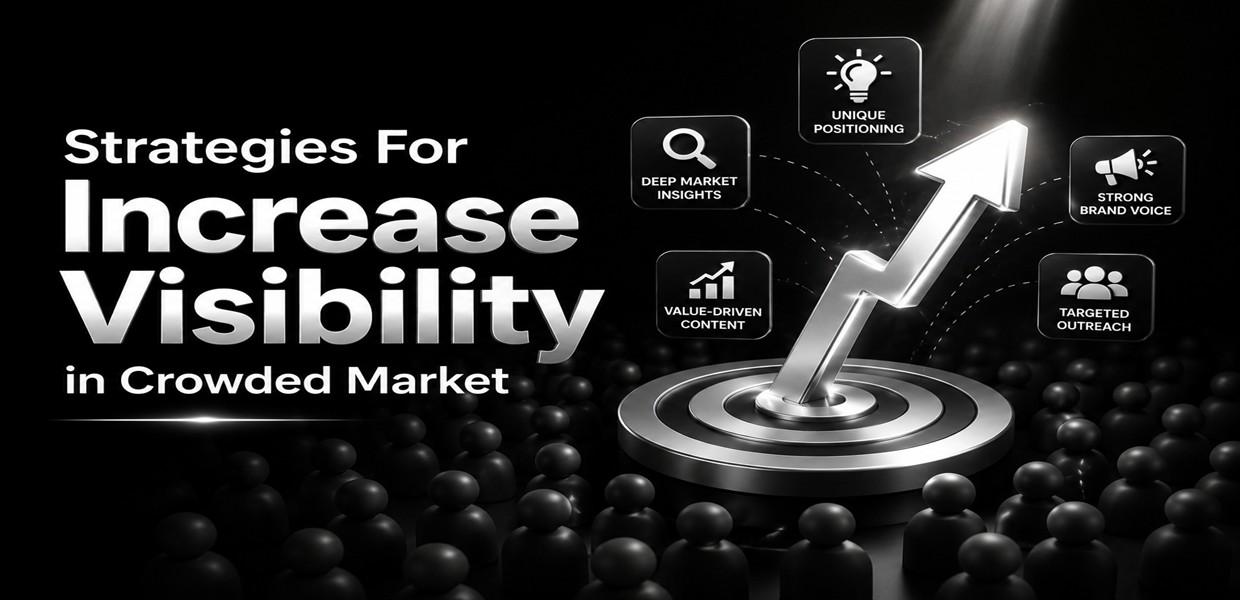

The most effective market visibility strategies for B2B brands combine intent-led SEO, sharp positioning, thought leadership, and proof-driven content that meets buyers during self-directed research. Because 80% of the B2B buying journey now happens without vendor contact (Gartner), visibility must be earned at the problem-search stage—not the sales stage—where buyers already have a shortlist.
For ten years I’ve watched capable B2B companies lose deals they never knew existed. Not because their product was weaker, but because the buyer finished researching, built a shortlist, and made a decision—all before a single sales rep got a call. In crowded markets, the question isn’t “are we good enough?” It’s “are we findable at the exact moment a buyer is trying to solve their problem?” This guide breaks down the strategies that put your brand in that window.
Key Takeaways
- 80% of the B2B buying journey now happens without direct vendor contact, and buyers spend just 17% of their time meeting suppliers (Gartner).
- 92% of buyers start with at least one vendor already in mind, and 41% have a single preferred vendor before formal evaluation begins (Forrester, 2024).
- 71% of B2B buyers begin research with a plain Google search, and over 80% trust organic results more than paid ads (Sopro, 2026).
What Are the Best Market Visibility Strategies for Crowded B2B Markets?
The best market visibility strategies make your brand discoverable at the problem-aware stage, differentiate it clearly from look-alike competitors, and back every claim with proof a buying committee can forward internally. In practice, that means owning intent-driven search terms, publishing thought leadership that answers real buyer questions, and structuring your site and content so AI engines and search crawlers can cite you.
This matters because the buyer has changed, not just the channels. Decision-makers now self-educate through an average of 11 pieces of content before contacting anyone, and the winning vendor is on the day-one shortlist roughly 95% of the time (6Sense, 2025). If you’re not visible during that early, independent research window, you’re not in the consideration set at all. The ten strategies below are sequenced from foundation (positioning) to amplification (PR and AI discoverability) so you can build durable brand visibility in competitive markets rather than chasing short-term reach.
What Are the 10 Market Visibility Strategies That Win Crowded Markets?
The ten market visibility strategies that win crowded markets are: sharp positioning, intent-led SEO, thought leadership, third-party proof, AI-answer optimization, borrowed authority through PR, channel sequencing, account-based targeting, community presence, and disciplined measurement. Each one moves your brand earlier into the buyer’s self-directed research—where the decision is actually formed—and together they compound into durable discoverability no single tactic can deliver alone.
- Stake an ownable position. Name who you’re for, what you replace, and why it’s better in one defensible claim. Clarity beats budget when ten competitors sound identical.
- Publish for problem-aware search. Target the questions buyers actually type (“how to reduce X”), not your product keywords—71% start with a plain Google search.
- Lead with thought leadership. Shape buyer preference before demand surfaces, since 41% already have a preferred vendor before evaluation begins (Forrester).
- Stack third-party proof. Case studies, quantified results, and reviews de-risk the choice for committees where 80%+ end up dissatisfied with their pick.
- Optimize for AI answers. Use answer-first blocks, question headings, and FAQ schema so generative engines cite you, not competitors.
- Borrow authority through PR. Guest articles, podcasts, and industry mentions transfer credibility faster than building domain authority alone.
- Sequence your channels. Lead with PR and LinkedIn for speed; layer SEO and thought leadership for compounding reach.
- Target named accounts. Concentrate visibility on the 6–10 stakeholders in each buying group rather than spraying broad impressions.
- Show up in trusted communities. LinkedIn, niche forums, and peer networks put you where 84% of buyers take recommendations.
- Measure leading indicators. Track branded search, share of voice, and AI-citation frequency—not just last-click leads—to prove momentum.
The sections that follow unpack the highest-leverage of these strategies in depth, with the data and execution steps behind each.
How Do You Get Found During the 80% of the Journey That Happens Without You?
You get found by publishing for the questions buyers actually search, not the keywords you wish they used. Buyers don’t search company names early on—they search problems. So your highest-visibility content should target problem-aware queries (“how to reduce X,” “best approach for Y”) and answer them better than anyone else on page one.
This is where content marketing for brand visibility earns its keep. Because 71% of buyers start with a Google search and most distrust paid ads, organic, genuinely helpful content is the cheapest seat at the table. Build topic clusters: one pillar page on a core problem, supported by deeper articles on each sub-question. Use clear, extractable answers near the top of every page so both readers and AI engines can lift them. Strong B2B brand visibility compounds—each indexed, useful page is a permanent salesperson working the 80% of the journey you’ll never see.
How Do You Make Your Brand Show Up in AI Answers, Not Just Google?
You show up in AI answers by structuring content so engines can extract and cite it confidently. Generative AI is now one of the most-cited research methods B2B buyers use—but 20% reported lower confidence after hitting inaccurate AI information (Forrester, 2025). That gap is your opening: clear, accurate, well-sourced content is exactly what AI engines prefer to cite.
Practical moves: open every page with a 40–60 word direct answer, use question-shaped headings that mirror real queries, add FAQ schema, cite credible sources, and keep claims specific and verifiable. Structured data and clean information architecture help crawlers and large language models map your expertise. As AI-mediated discovery grows, brands that format for extractability will dominate the answer box while competitors stay buried in paragraph four.
Best Visibility Channels for B2B Brands: Which Should You Prioritize?
Prioritize channels by where your buyers research and how quickly each compounds. There’s no universal best channel—but there is a defensible priority order for most B2B brands entering a crowded market. The table below maps each channel to its primary visibility role, speed to results, and ideal use.
|
Channel |
Primary Visibility Role |
Speed to Results |
Best For |
|
Organic search / SEO |
Found during problem-aware research |
Slow, compounding |
Long-term, durable discoverability |
|
Thought leadership content |
Shapes preference pre-demand |
Medium |
Differentiation & authority |
|
LinkedIn (organic) |
Decision-maker presence |
Medium |
Reaching buying committees |
|
PR & industry publications |
Borrowed authority |
Fast |
New or challenger brands |
|
Review platforms (G2, etc.) |
Trust validation |
Medium |
De-risking the shortlist |
|
AI / answer-engine optimization |
Citation in AI responses |
Medium, rising |
Future-proofing discoverability |
|
Paid search & social |
Targeted reach |
Fast |
Filling pipeline gaps |
The strongest programs don’t pick one—they sequence. Lead with PR and LinkedIn for early momentum, build SEO and thought leadership for compounding visibility, and layer AEO and reviews so you’re both findable and trusted. That blend is what sustainable market visibility strategies look like in practice.
How Do You Measure Whether Your Visibility Strategy is Actually Working?
You measure visibility by tracking presence at the research stage, not just leads at the bottom. Branded search volume, share of voice for target keywords, organic impressions on problem-led terms, AI-citation frequency, and direct-traffic growth all signal whether buyers are finding and remembering you earlier. Because attribution is famously messy—61% of B2B marketers say they lack a clear view of the customer journey (Forrester)—leading indicators beat last-click obsession.
Watch movement over quarters, not days. Visibility is a compounding asset: rankings, citations, and brand recall build slowly then tip. Set a baseline now—current keyword positions, branded search, review counts—and review monthly. When branded search and direct traffic start rising without added ad spend, your positioning and content are working. That’s the quiet signal that you’ve moved from invisible to inevitable in your category.
Conclusion:
Visibility in a crowded market isn’t won by shouting louder—it’s won by being findable, differentiated, and trusted at the exact moment buyers are researching without you. Start here:
- This week: Write one ownable positioning statement—who you’re for, what you replace, why it’s better—and audit your homepage against it.
- Next two weeks: Identify the top five problem-aware questions your buyers search, and publish or rewrite one page with a 40–60 word answer up top plus FAQ schema.
- This month: Pitch one contributed article or podcast appearance to a publication your buyers already trust, and collect two forwardable proof points (a quantified result + a review).
Do these three things and you’ll be visible where 80% of the decision actually happens. The brands that win crowded markets aren’t the biggest—they’re the ones buyers find first and remember longest.