
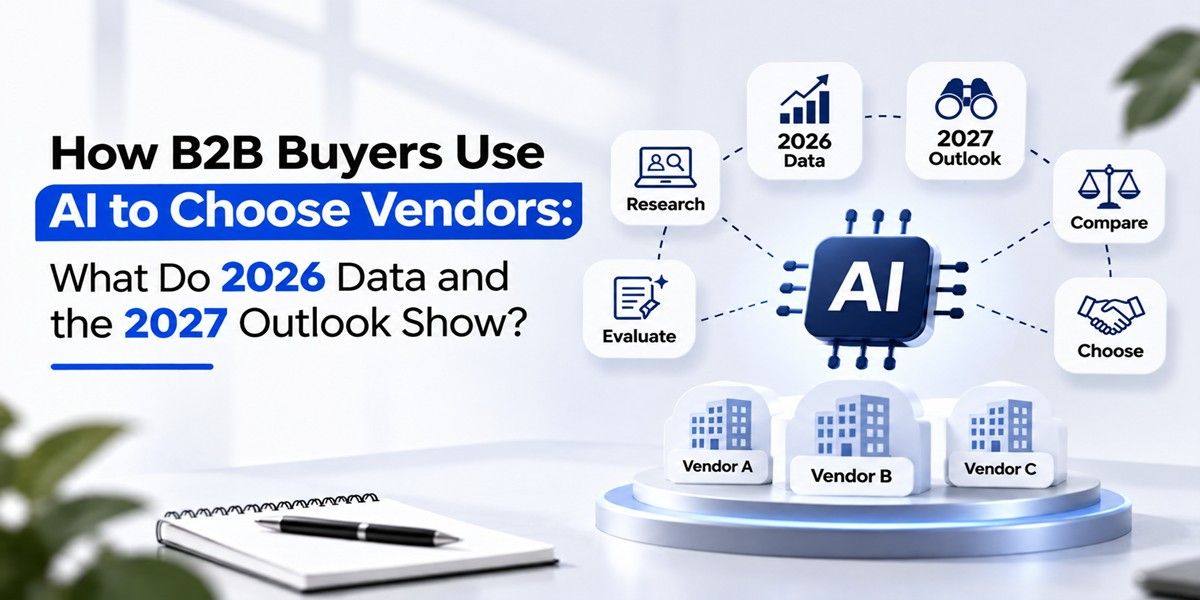
B2B buyers use AI to choose vendors by asking AI assistants to build shortlists, compare options, and check vendor claims, then confirming the results with peers and reviews. Forrester found 94% of business buyers use AI during purchasing, and G2 reports 51% of software buyers now start research in an AI chatbot.
Last year your sales team met buyers who had read your website. This year they meet buyers who have read a summary of your website, your reviews, your pricing page, and your competitors’ counterarguments, all assembled by an AI in under a minute. By the time a buyer books a demo, the list is short, and you are either on it or not.
In more than a decade in B2B, I have not seen buyer behavior change this quickly. The useful response is to look at what the 2026 research says buyers actually do, and to plan for what analysts expect in 2027.
Key takeaways
- 94% of business buyers use AI during the buying process (Forrester Buyers’ Journey Survey of nearly 18,000 buyers).
- 51% of B2B software buyers start research in an AI chatbot, and 69% chose a different vendor than planned after AI guidance (G2, 2026).
- Forrester predicts agentic buying will play a role in 75% of B2B purchases in 2027.
How do B2B buyers use AI to choose vendors in 2026?
B2B buyers use AI across the whole purchase, not only at the start. They ask it to explain a category, name candidates, compare them, estimate cost, and test what salespeople say.
G2’s 2026 Buyer Behavior research shows where the use is heaviest. The most common jobs buyers give AI are understanding total cost of ownership (51%), building shortlists (51%), researching solutions (49%), and evaluating shortlisted vendors (46%). AI is busiest in the middle of the journey, where options are narrowed.
This is self-serve research at a new level. A buyer no longer reads ten vendor sites. They ask one question and receive a structured comparison. The data on B2B buyers AI vendor research habits is consistent across studies: it is frequent, it is early, and it shapes who gets a meeting. For background on the wider shift, see the B2B buyer journey has changed.
How much of the buying process now happens inside AI tools?
Most of the early process now happens inside AI tools, before a vendor knows a buyer exists. Forrester’s Buyers’ Journey Survey of nearly 18,000 global business buyers found that 94% use AI during the buying process. G2 found that 51% of B2B software buyers begin in an AI chatbot, not a search engine.
Image alt text: Bar chart of 2026 Forrester and G2 data on how B2B buyers use AI during vendor research
The influence is real. In G2’s research, 69% of buyers said they chose a different vendor than they first planned because of AI guidance, and one third bought from a vendor they had never heard of.
For leaders, this is the dark funnel getting darker. Research that once left traces in your analytics, such as page views and downloads, now happens in a chat window you cannot see. Pipeline reports will understate how many buyers considered you, and how many ruled you out. Our article on why B2B SaaS brands are invisible to AI search explains the visibility gap.
What do buyers ask AI at each stage of a purchase?
Buyers ask AI different questions at each stage, and each one is a chance to be included or left out. The table maps the pattern.
Stage | What buyers ask AI | What vendors need |
Discovery | “What tools solve this problem for a company like ours?” | Clear category and use-case language across the web |
Shortlisting | “Give me the top five options and why.” | Mentions in reviews, comparisons, and trusted publications |
Evaluation | “Compare A and B on price, security, and integrations.” | Public, specific facts on pricing and capabilities |
Validation | “Is this claim true? What do customers say?” | Consistent proof and recent customer reviews |
Renewal | “Are there better alternatives now?” | Ongoing evidence of value and customer advocacy |
Two points stand out. First, the AI vendor shortlist forms early, often before any salesperson is involved. Second, AI does not stop at purchase. AIRI research found 91% of buyers are likely to use AI at contract renewal to find or vet alternatives. Even formal steps are changing, as procurement teams begin using AI to draft RFP questions.
Do buyers trust what AI tells them?
Buyers trust AI enough to start with it, but not enough to finish with it. They treat AI answers as a first draft and then look for confirmation.
G2 found that 85% of buyers require proof from multiple independent sources before deciding, and 64% still rely on original vendor sources to make final choices. AIRI found 62% use AI itself to fact-check sales claims against public sources. Buyers confirm in three places:
- Peer reviews on platforms such as G2, and conversations in professional communities.
- Human experts, including analysts, consultants, and people in their network.
- The vendor’s own material: documentation, pricing, security pages, and trials. Forrester reports more than 60% of buyers used some form of trial.
The lesson is that trust signals have to agree. If AI says one thing, reviews say another, and your sales deck says a third, the buyer moves on. Our guide to AI citation patterns shows which sources AI tools lean on.
Who makes the decision, and how does AI change the group?
Decisions are still made by people, and by more of them than before. Forrester puts the average at 13 internal stakeholders and nine external participants per purchase. AI changes how that group works in three ways:
- Every member arrives informed. Finance, security, and end users each run their own queries and form a view before the first meeting.
- Objections surface faster. A buying committee member can ask AI for a vendor’s weaknesses in seconds.
- The champion needs help. One person has to reconcile many AI-informed opinions.
For vendors, this means writing for roles, not just for a company. A CFO asks about cost and risk. A security lead asks about compliance. If your public content answers only the end user’s questions, the AI assistants B2B buying groups rely on will answer the other stakeholders from someone else’s content. Give champions plain-language material they can share with each function.
What will change in 2027?
In 2027, AI will move from advising buyers to acting for them, while people keep the final say. Forrester’s 2027 predictions state that agentic buying will play a role in 75% of B2B purchases, with agents handling tasks such as supplier discovery, information gathering, and renewal analysis. G2 already finds 61% of buyers use or plan to use AI agents in buying.
Image alt text: Bar chart showing G2 2026 survey data and Forrester 2027 and Gartner 2028 predictions on AI agents in B2B buying
Forrester also expects buyers to double their human interactions to validate AI recommendations. More automation will bring more demand for human proof, not less.
Further out, Gartner predicts that by 2028, 90% of B2B buying will be intermediated by AI agents, covering more than $15 trillion in spend. Forecasts are not facts, and timelines slip. But analysts agree on the direction. Your next evaluator may be software, and it will read what is public, structured, and verifiable.
What should vendors do to be chosen?
Vendors get chosen when AI can find them, describe them accurately, and back up what they say. Five actions cover most of the gap:
- Test your presence. Ask the main AI tools the questions your buyers ask. Record who is named and how you are described.
- Publish the facts buyers compare. Pricing models, integrations, security, and implementation time should be public and specific.
- Earn third-party proof. Recent reviews, analyst mentions, and customer stories are what AI and buyers both check.
- Write for every role. Cover finance, security, IT, and end users in separate, clear answers.
- Equip sales to validate. Buyers arrive informed, so reps should confirm, correct, and add depth during vendor evaluation.
The B2B buyer journey AI has reshaped still ends with a human decision. Your job is to make that decision easy to defend. For practical steps, see how to increase brand mentions and citations in AI search and our guide to B2B brand visibility in AI search and LLMs.
Conclusion
The research on how B2B buyers use AI to choose vendors points one way. Buyers start with AI, narrow with AI, and then verify with people and proof. In 2027, agents will take on more of the legwork.
Start with three moves this month:
- Run a buyer-prompt audit across ChatGPT, Google, and Perplexity, and share the results with your leadership team.
- Fix the three biggest gaps between what AI says about you and what is true.
- Launch a review and customer-proof program with a named owner.
Then repeat the audit each quarter and align it with your sales strategy. The vendors that win will not be the loudest. They will be the ones whose story is the same everywhere a buyer, or a buyer’s agent, looks.
FAQs:
How many B2B buyers use AI to research vendors?
Most do. Forrester’s Buyers’ Journey Survey found 94% of business buyers use AI during the buying process. G2 reports that 51% of B2B software buyers start their research in an AI chatbot, and 71% rely on AI chatbots for software research, up from 60% previously.
Which AI tools do B2B buyers use for vendor research?
Buyers use general AI assistants such as ChatGPT, Google’s AI features, Perplexity, and Microsoft Copilot, along with AI tools supplied by their employers. They use them to explain categories, build shortlists, compare vendors, estimate costs, and check sales claims against public sources.
Do B2B buyers trust AI recommendations?
Partly. Buyers trust AI to speed up research, but they verify before deciding. G2 found 85% require proof from multiple independent sources, and 64% still rely on original vendor sources for final choices. Reviews, experts, and product trials remain the main ways buyers confirm AI output.
How can a vendor get on an AI-generated shortlist?
Make your brand easy for AI to find and verify. Publish clear, specific facts about your product and pricing, earn recent reviews and third-party mentions, keep your description consistent across the web, and answer the questions each stakeholder asks. Then test regularly with real buyer prompts.
Will AI agents replace human B2B buyers in 2027?
No. Forrester predicts agentic buying will play a role in 75% of B2B purchases in 2027, but people keep the final decision. Agents will handle discovery, information gathering, and comparison, while buyers increase human contact to validate what AI recommends.