
B2B brand discovery in 2026 happens inside AI answers, peer communities and review platforms — not on your homepage. 94% of B2B buyers now use generative AI during their purchase process (6sense, 2025), and 61% of the B2B buyer journey completes before a vendor is ever contacted (Forrester, 2025, n=4,000+). If your brand is not cited where buyers ask their questions, you are not on the shortlist — you are not even in the room.
I have sat on both sides of this table for over a decade — building demand for B2B software companies, and being the buyer that vendors were trying to reach. The single biggest change I have seen is not that buyers got smarter. It is that buyers stopped starting with you.
Ten years ago, a VP of Operations with a problem opened Google, typed a category term, clicked three blue links, and downloaded a whitepaper. Today, that same VP opens ChatGPT and types: “We’re a 400-person logistics firm — what are the best warehouse management platforms for mid-market, and what are the trade-offs?” Ninety seconds later she has a five-vendor list, a pros-and-cons grid, and three follow-up questions she never would have thought to ask. Your marketing team saw none of it. No session. No form fill. No signal. And yet the vendor shortlist is already written.
That is the shift. The modern B2B buyer journey is no longer a funnel you fill. It is a conversation you are either cited in — or absent from.
KEY TAKEAWAYS
- 94% of B2B buyers used generative AI tools during their purchase process, up from 89% a year earlier (6sense, 2025 Buyer Experience Report).
- 33% of B2B buyers purchased from a vendor they had never previously heard of — discovered entirely through an AI-generated answer (G2 Answer Economy Report, March 2026, n=1,076).
- 61% of the buying journey is complete before a vendor is contacted (Forrester, 2025, n=4,000+), and buying committees now run to 6–14 stakeholders on complex deals.
- AI search traffic converts at 14.2% versus 2.8% for traditional organic — a 5.1x advantage — yet only 22% of marketers track AI visibility at all (Loganix 2026 B2B AI Buying Behavior Analysis).
What has actually changed in the B2B buyer journey?
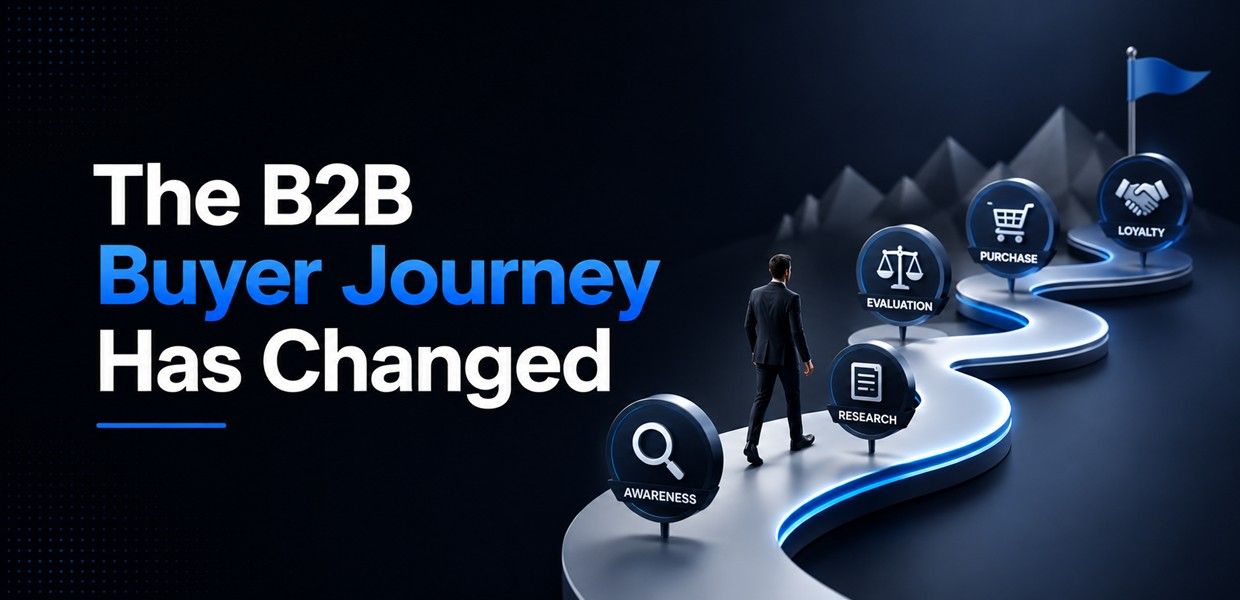
The B2B buyer journey has changed in one specific way: discovery moved from search results to synthesized answers. Everything else — the committee, the risk aversion, the long deliberation — is broadly the same. What broke is the front door.
In the old B2B buying process, a buyer performed a query and received a page of options to evaluate for themselves. The buyer did the sorting. In 2026, the buyer performs a prompt and receives a recommendation that has already done the sorting. Forrester’s 2026 Buyers’ Journey Survey of nearly 18,000 global business buyers found that generative AI and conversational search are now the most-cited source of vendor research — outranking vendor websites, product experts and sales reps, with roughly twice as many buyers naming AI as their top source than any other channel.
The practical consequence for B2B leaders is uncomfortable. Brand equity built over a decade can be silently bypassed by a model that simply does not mention you. And the same mechanism that excludes an incumbent can lift an unknown challenger straight onto a shortlist. Discovery is no longer earned by budget. It is earned by citation.
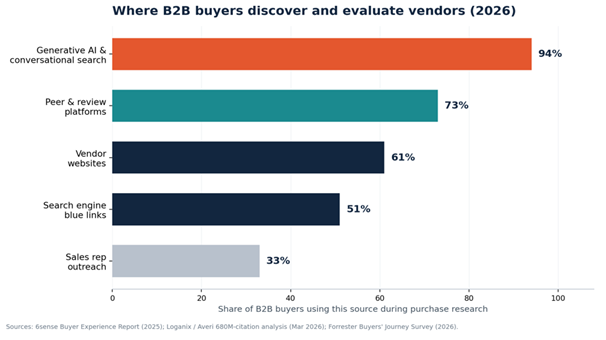
Where B2B buyers discover and evaluate vendors in 2026. AI-assisted research now precedes every other channel.
Where do B2B buyers discover brands in 2026?
B2B buyers now discover brands through four surfaces, in this order: AI assistants, peer and review platforms, communities such as Reddit and LinkedIn, and only then vendor-owned properties. The order matters more than the list, because each surface feeds the next.
Why is the traditional funnel failing modern B2B brand discovery?
The traditional funnel fails because it assumes discovery is a stage buyers pass through once. It is now a loop they re-enter continuously and re-entering means re-prompting.
A buyer asks an assistant to name the leading vendors. She reads the answer. She goes to a review platform to sanity-check it. She asks a peer in a Slack community. She returns to the assistant and asks it to compare the two names that survived. Each pass through that loop is a fresh comparison research moment, and each one is a chance for your brand to enter — or be removed. Traditional B2B content marketing was designed to nurture a known contact through linear stages. It has almost nothing to say about an anonymous buyer running a comparison research loop that never touches your domain.
This is why 86% of B2B purchases stall (Forrester, State of Business Buying) despite record content volume. Buyers are not short of information. They are short of confidence — and confidence is built through corroboration across independent sources, not through one more nurture email.
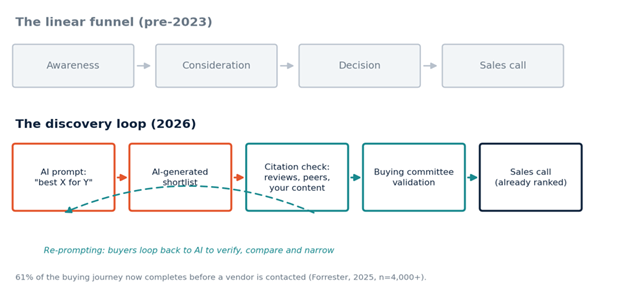
The linear funnel versus the 2026 discovery loop. Buyers
re-enter research repeatedly before ever raising a hand.
How does the buying committee change what content you need?
A buying committee does not consume content — it negotiates with it. Complex B2B deals now involve between 6 and 14 stakeholders, and each one arrives with a different question, a different risk, and a different assistant.
The champion is asking whether the platform solves the problem. Finance is asking about total cost and switching risk. IT is asking about integrations and security posture. Procurement is asking who else in the industry has bought this. If your content answers only the champion’s question, the deal stalls at the exact moment it leaves the champion’s hands.
Effective buyer enablement in 2026 means producing content the champion can forward without editing. That means specifics, not adjectives: implementation timelines with real numbers, integration lists by name, pricing logic even if not pricing, and honest statements about who the product is not for. Buyers — and the assistants summarising for them — reward that kind of clarity, because it reduces the work of building an internal case.
Why does discovery by citation now decide the vendor shortlist?
Because the shortlist is written before you know a deal exists. Roughly 80% of B2B deals go to the vendor that was the buyer’s pre-contact favourite and that favourite is being chosen in a conversation you are not part of.
Discovery by citation is the mechanism that decides who gets into that conversation. When an assistant answers a category question, it does not consult your ad budget or your brand tracker. It assembles an answer from sources it can retrieve, parse and trust: structured pages that answer the question directly, third-party review platforms, community discussions, comparison pages, analyst coverage and data-rich original research.
This has an unfamiliar implication for B2B leaders raised on paid acquisition. The most valuable real estate in modern B2B brand discovery is often not owned by you at all. A single well-argued Reddit thread, a G2 category page or an independent comparison post can carry more shortlist influence than your entire blog — because it is the source the assistant reaches for. You cannot buy that placement. You can only earn it, and then make sure your own pages are structured well enough to be quoted alongside it.
Your best content is invisible and here is why
Most B2B brands are not losing because their content is weak. They are losing because their content is unreadable to the systems now doing the recommending.
Three failure modes account for most of it. First, gating: your best comparison asset, the one that would win the shortlist argument, sits behind a form where no crawler and no assistant will ever see it. Second, burial: the answer to “how much does it cost to implement” exists — in paragraph nine of a 3,000-word thought-leadership essay, phrased as a hedge. Third, vagueness: pages full of “scalable, enterprise-grade solutions” contain no extractable claim, so there is nothing for a model to lift and attribute.
The fix is structural, not creative. Lead every page with a direct, self-contained answer. Use question-shaped headings that mirror how buyers actually prompt. Put comparisons in tables. Attach numbers, dates and named sources to claims. Publish original data nobody else has. Content built this way earns citations in AI-powered search and reads better for humans at the same time — which is the whole point of helpful content, and always was.
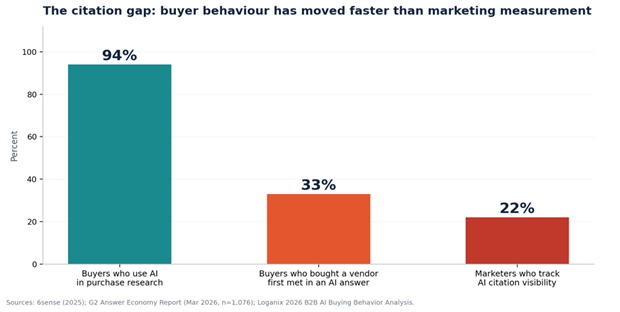
The citation gap. Buyer behaviour has moved faster than
the measurement models most B2B teams still run on.
Which discovery channels work best for which stage of the B2B buyer journey?
No single channel covers the whole journey. The table below maps each discovery surface to the stage it actually influences, the signal you can measure, and where most teams get it wrong.
Discovery channel | Best for this stage | What to measure | Common mistake |
AI assistants (ChatGPT, Perplexity, Gemini, Claude) | Problem framing and initial vendor shortlist | Share of category prompts where your brand is named and cited | Publishing gated or vague content that models cannot extract or attribute |
Review platforms (G2, Capterra, TrustRadius) | Validation and comparison research | Review volume, recency and category placement | Harvesting reviews once at launch, then letting them age out of relevance |
Communities (Reddit, LinkedIn, Slack groups) | Peer corroboration and risk reduction | Unprompted brand mentions and sentiment | Astroturfing — which is detected, punished and permanently damaging |
Organic search and comparison pages | Deep evaluation and internal business case building | Rankings plus AI Overview citation rate | Optimising for keywords instead of for extractable answers |
Owned research and original data | Authority, and being the source others cite | Third-party citations and referring domains | Recycling other people’s statistics instead of publishing your own |
How should B2B leaders rebuild their brand discovery strategy?
Start by measuring what you cannot currently see. Only 22% of marketers track AI visibility, which means the channel now driving the most consequential moment in the B2B purchase journey is, for most companies, entirely unmeasured.
A practical sequence for the next two quarters:
- Audit your citation share. Run your 30 highest-intent category and comparison prompts across the major assistants. Record whether you appear, in what position, and which sources are cited about you. That baseline is your new share-of-voice.
- Fix your extractability. Ungate the comparison assets. Add answer-first blocks to your top 20 commercial pages. Convert dense prose into tables. Give every claim a number and a source.
- Invest where the assistant looks. Review platform freshness, community presence and independent third-party coverage are now demand-generation infrastructure, not PR nice-to-haves.
- Publish something only you can publish. Original data from your own customer base is the single most citable asset a B2B brand can produce, and it compounds.
- Enable the committee, not just the champion. Build the finance page, the security page and the switching-cost page you have been putting off.
Conclusion
The uncomfortable truth for B2B leaders in 2026 is that your brand is being described to buyers, constantly, by systems you do not control, using sources you did not choose. You cannot opt out of that conversation. You can only decide whether the description is accurate, specific and favorable — or whether it omits you entirely.
The good news is that the work required is not exotic. It is the work good B2B marketing always demanded and rarely delivered: answer the question directly, prove the claim with data, be honest about fit, and earn the right to be recommended by people who owe you nothing. The assistants simply made that discipline non-negotiable.
Your one action this week: open an AI assistant, ask it the question your best-fit buyer would ask to find a vendor like you, and read the answer carefully. Whatever it says — or fails to say — is your real brand position. Everything else is a slide deck.