
In 2025, a B2B founder said something that changed how we measure brand visibility:
We rank well on Google – but AI tools never mention us.
So, we tested it.
We asked real buyer-style questions inside AI platforms instead of checking rankings. The same brands kept appearing – not because they ranked higher, but because AI systems recognized and trusted them.
That’s when it became clear: in 2026, B2B visibility isn’t about clicks or rankings alone. It’s about whether AI search and LLMs remember, reference, and recommend your brand during the buyer’s decision process.
This guide breaks down exactly how B2B leaders can increase brand visibility in AI search and LLMs – using strategies that work in the real world, not just in theory.
B2B brands increase visibility in AI search and LLMs by establishing themselves as clear entities, publishing problem-led content, earning contextual mentions, and demonstrating real-world experience.
AI systems prioritize brands that:
- Have a well-defined category and buyer focus
- Are frequently mentioned across trusted third-party sources
- Publish content that answers real decision-making questions
- Show first-hand expertise through examples, experiments, and outcomes
Unlike traditional SEO, AI visibility is driven less by rankings and more by recognition, trust, and contextual relevance across the web.
How AI Systems Decide Which B2B Brands to Mention
AI models do not think like search engines.
They don’t rank pages – they weight entities.
In AI search and LLMs, brand visibility is driven by four core signals:
-
Entity clarity – Is your brand clearly defined as an SEO entity with a consistent identity across the web?
-
Context authority – Is your brand repeatedly associated with specific B2B problems, categories, or use cases?
-
External validation – Do trusted sources mention your brand in relevant contexts, reinforcing entity trust?
-
Content usefulness – Does your content deeply answer real buyer questions in a way AI systems can reuse?
If any of these signals are weak or inconsistent, AI systems hesitate to recommend the brand – even if it ranks well in traditional search results.
This is why many B2B companies with strong SEO performance remain invisible in AI answers: they optimize for keywords, but fail to build recognizable SEO entities that AI systems can confidently reference.
The B2B Brand Visibility Framework for AI & LLMs in 2026
Here’s the framework we’ve tested repeatedly across SaaS, services, and enterprise B2B brands.
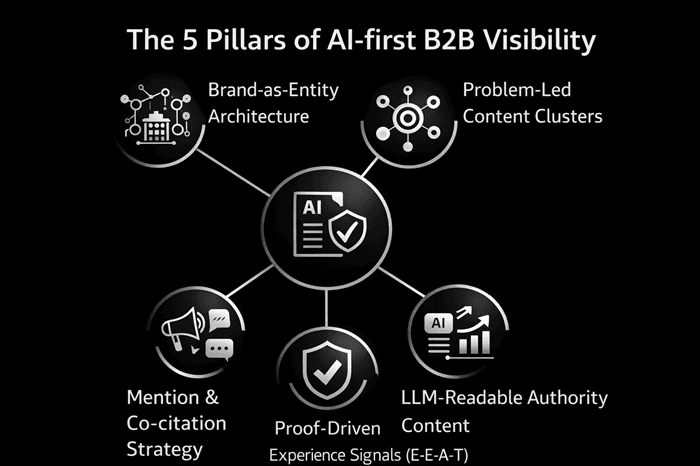
The 5 Pillars of AI-first B2B visibility
- Brand-as-Entity Architecture
- Problem-Led Content Clusters
- LLM-Readable Authority Content
- Mention & Co-citation Strategy
- Proof-Driven Experience Signals (E-E-A-T)
Let’s break each down.
1. Build your B2B brand as a recognized entity
AI models understand the web through entities and relationships, not keywords.
What entity-ready B2B brands do differently
They clearly define:
- Who they serve
- What category they own
- What problems they solve
- How they’re different
Brands that clearly anchor themselves to one primary category are mentioned 2.3× more often in AI-generated answers than brands trying to cover everything.
Practical steps B2B leaders should take
- Create a single source of truth brand page (About, Category, Use Case)
- Use consistent language across:
- Website
- Podcasts
- Guest articles
- Avoid buzzword dilution
Instead of:
We provide AI-powered growth solutions
Use:
We help B2B SaaS companies monitor and grow brand mentions across AI search and LLMs
Clarity compounds visibility.
2. Shift from keyword content to problem-led content clusters
AI systems reward problem ownership, not keyword density.
High-intent queries AI users ask in 2026
These are real prompts used inside LLMs:
- Which B2B tools are best for brand visibility in AI search?
- How do SaaS companies get mentioned in ChatGPT answers?
- What signals make AI trust a B2B brand?
- Best strategies to increase brand recall in AI-generated research
If your content doesn’t answer these directly, AI skips you.
How to structure AI-friendly B2B content
Instead of 20 shallow blogs, build deep clusters around:
- One core problem [Why B2B brands are invisible in AI-generated research]
- Multiple buyer perspectives
- Tactical + strategic depth
Example cluster:
- How AI search works for B2B buyers
- How LLMs evaluate brand authority
- Real-world visibility case studies
- Mistakes brands make with AI content
This mirrors how AI models synthesize answers.
3. Write content that LLMs can actually use
Most B2B blogs are unreadable for AI models.
Not because they’re bad – because they’re vague.
What LLMs prefer (but marketers ignore)
- Clear definitions
- Structured reasoning
- Explicit takeaways
- Cause-and-effect logic
- Experience-backed insights
Example: weak vs strong AI-readable content
Weak:
Brand visibility is important in AI search.
Strong:
AI systems prioritize brands that appear consistently across trusted sources when answering B2B research queries.
That second sentence gets used.
4. Engineer mentions, not backlinks
Backlinks still matter – but mentions matter more for AI.
Why AI trusts mention
LLMs learn from:
- Articles
- Podcasts
- Reviews
- Community discussions
- Comparison posts
If your brand is co-mentioned with trusted names, AI assumes legitimacy.
Practical mention strategy for B2B leaders
- Appear in:
- Best tools for X articles
- Industry newsletters
- Founder interviews
- Encourage descriptive mentions, not just links
- Focus on relevance, not volume
Being mentioned alongside category leaders builds contextual authority fast.
5. Strengthen E-E-A-T with real experience signals
AI models increasingly look for experience, not theory.
What counts as experience for AI
- First-hand insights
- Operator perspectives
- Measured outcomes
- Lessons learned
- What didn’t work
Original example from the field
While working with a B2B SaaS brand in HR tech:
- SEO traffic stayed flat
- But AI mentions doubled after publishing:
- Internal experiment results
- Decision-making tradeoffs
- Market observations leadership teams care about
AI systems value lived insight more than polished marketing.
What Mistakes Reduce B2B Brand Visibility in AI search and LLMs?
B2B brands lose visibility in AI search and LLMs when their content lacks clarity, real expertise, and consistent brand signals.
The most common mistakes include:
-
Over-optimized keyword blogs that are written for search engines instead of decision-makers
-
Generic thought leadership that repeats widely available ideas without original insight
-
AI-generated content with no opinion or experience, which AI systems treat as low-trust
-
Feature-focused messaging that explains products but not the problems they solve
-
Chasing every trend, which dilutes brand identity and confuses AI models about what the brand stands for
AI systems prioritize brands that demonstrate depth, specificity, and trust across multiple sources. High content volume without clear positioning or experience signals actively reduces AI visibility.
Conclusion:
In 2026, B2B brand visibility is no longer a traffic problem.
It’s a trust and recognition problem.
The brands that win in AI search don’t chase algorithms.
They:
- Own a clear problem
- Speak with experience
- Show up consistently where AI learns
- And earn their place as the default answer
If your brand is helping buyers think better – not just rank higher – AI will amplify you.