
If you’ve been in SEO long enough, you can feel it: something fundamental has shifted.
Ranking #1 no longer guarantees visibility.
Publishing optimized content no longer guarantees discovery.
And answering the right keyword no longer guarantees attribution.
In 2026, search doesn’t just look for pages – it looks for brands it understands.
Behind every AI-generated answer, featured snippet, or conversational response is a silent decision:
Which brand do we trust enough to mention?
That decision is driven by entities.
This guide explains in practical, non-theoretical terms why SEO entities now sit at the center of visibility, how AI and search engines decide who gets cited, and what brands must do now to stay relevant in an AI-first search ecosystem.
Search Isn’t Broken – It’s Just Grown Up
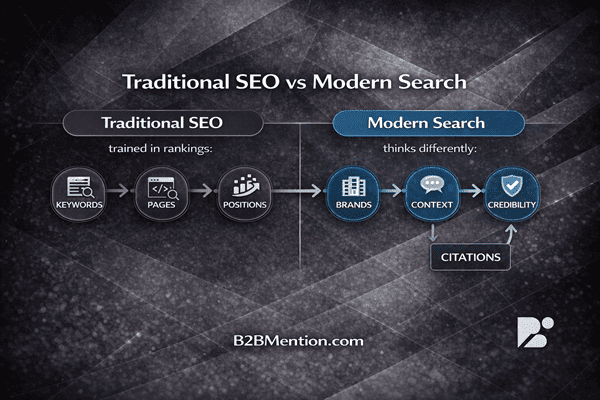
Traditional SEO trained us to think in rankings:
- Keywords → pages → positions → clicks
Modern search thinks differently:
- Brands → context → credibility → citations
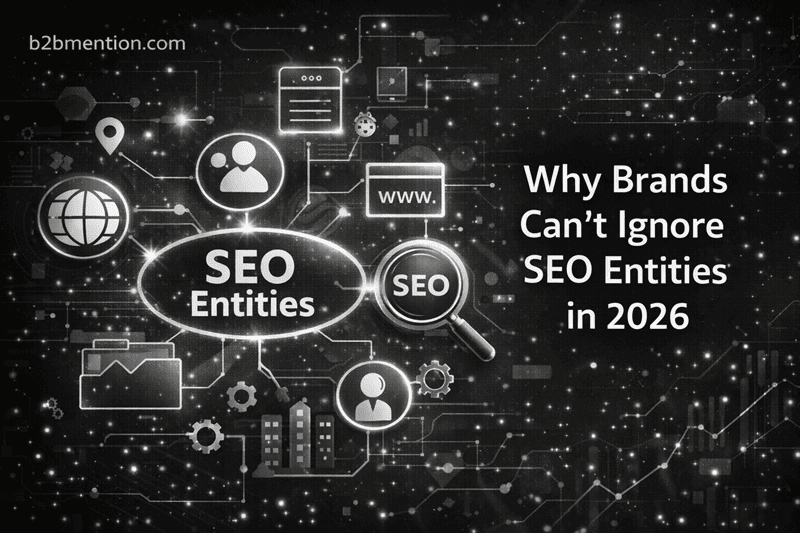
Search engines and AI systems now build understanding layers around real-world things – companies, products, people, tools, categories. These are entities.
Your website is no longer evaluated in isolation.
It’s evaluated as evidence that supports (or weakens) your brand’s identity.
That’s the quiet change many teams haven’t internalized yet.
What an SEO Entity Really Is
An SEO entity is not a schema tag.
It’s not a Knowledge Panel.
It’s not Wikipedia (though that helps).
An entity is how confidently a system can say:
I know who this brand is, what it does, and why it’s credible.
An entity forms when search engines can consistently answer:
- Who are you?
- What category do you belong to?
- What are you known for?
- Who references you?
- Where does independent evidence exist?
When that clarity exists, AI systems feel safe mentioning your brand by name.
When it doesn’t, they avoid you – even if your content is good.
An entity is a clearly-identifiable real-world thing like a person, company, product, concept, or place – that search engines connect to facts, attributes and relationships. The Knowledge Graph (and similar internal graphs used by AI systems) stores entities and then answers queries by selecting the best-connected, most trustworthy nodes, not just the best-performing URL for a keyword. Google even exposes a Knowledge Graph API for entity lookup and verification.
Why Entity SEO Became Non-Negotiable in 2026
Three forces collided:
- AI Answers Reduced Clicks, Not Questions
People still ask questions – they just don’t always click anymore.
AI answers often end the journey inside the interface.
That means being cited matters more than being ranked.
- AI Can’t Guess – It Needs Verifiable Brands
Large language models don’t invent brand trust.
They rely on patterns: mentions, consistency, authority signals.
If your brand lacks strong entity signals, AI systems default to safer names.
- Authority Is Now Distributed, Not Owned
Your homepage alone no longer defines you.
Your identity is shaped by:
- Third-party mentions
- Industry references
- Author credibility
- Structured clarity
- Repetition across the web
You don’t own your entity – you earn it.
The Quiet Risk: Ranking Without Being Remembered
One of the most dangerous states in SEO today is this:
We’re still ranking, but no one mentions us.
Brands in this position often experience:
- Stable keyword positions
- Declining brand recall
- Zero presence in AI answers
- Fewer inbound leads over time
They are visible but unrecognized.
Entity SEO is what converts visibility into memory.
6 Real Business Risks of Ignoring Entity SEO
- You Disappear From AI Answers
When buyers ask tools for recommendations, comparisons, or explanations, your brand isn’t named – even if your blog ranks.
- Traffic Becomes Unpredictable
As AI answers replace clicks, organic traffic becomes volatile for brands without citation equity.
- Your Brand Story Gets Fragmented
Inconsistent About pages, mismatched bios, outdated listings – all weaken entity clarity.
- Competitors Define Your Category
If others are cited more often, they become the default mental model for your market.
- Attribution Gets Messy
AI referrals don’t always show up cleanly in analytics. Without entity tracking, growth appears mysterious.
- SEO Becomes Harder Every Quarter
Because rebuilding trust takes longer than building pages.
The Entity Signals That Actually Influence AI & Search
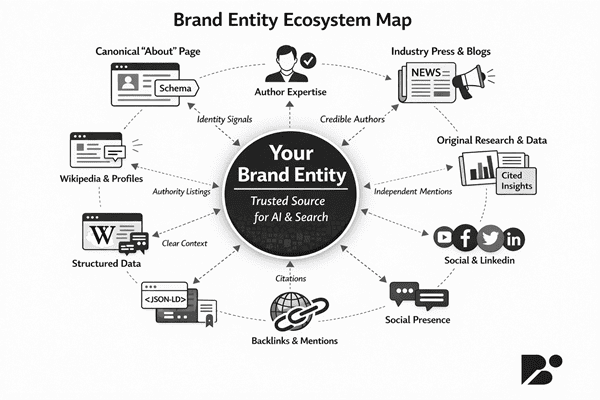
Not all SEO work contributes equally to entity strength.
Here’s what actually moves the needle.
- A Single, Clear Brand Identity Hub
Your About page should function like a source of truth:
- What you do
- Who you serve
- What makes you different
- Where else you exist online
This is where structured data supports meaning – not the other way around.
- Real Humans Behind the Content
Anonymous content weakens trust.
Strong entities have:
- Named authors
- Consistent bios
- Verifiable experience
- Topical alignment between author and subject
AI systems trust people before they trust pages.
- Independent Mentions That Aren’t You Talking About Yourself
Mentions without links still matter.
Industry blogs, podcasts, reports, newsletters, comparison pages – all act as external validation that your brand exists outside its own site.
- Structured Data Used With Restraint
Schema helps machines connect dots – but overuse creates noise.
Focus on:
- Organization
- Person
- Product
- FAQ
Accuracy > volume.
- Branded Search Demand
When people actively search your name, it reinforces relevance.
This often grows through:
- Thought leadership
- Original research
- Social proof
- Community presence
- Original Insights Others Can Reference
Nothing strengthens entity authority like being the source.
Benchmarks, data studies, frameworks, or models that others cite give AI systems something concrete to trust.
- Consistency Across Platforms
Your brand should look like the same company everywhere:
- Same positioning
- Same category language
- Same leadership signals
Entity confusion kills trust.
A Realistic Scenario for SEO Entity
A B2B SaaS brand publishes a proprietary industry report.
They:
- Attach real authorship
- Get referenced by 5 industry blogs
- Add structured context on their site
Within months:
- Their brand appears in AI explanations
- Sales leads mention seeing them cited
- Their content is surfaced beyond rankings
Nothing viral.
Nothing gimmicky.
Just entity clarity.
Final Thought:
SEO Is Becoming Brand Memory Engineering
In 2026, SEO isn’t just about traffic.
It’s about being the brand AI remembers when questions are asked.
Keywords help you show up.
Entities decide if you get named.
And brands that invest early in entity clarity don’t just survive algorithm changes,
they benefit from them.