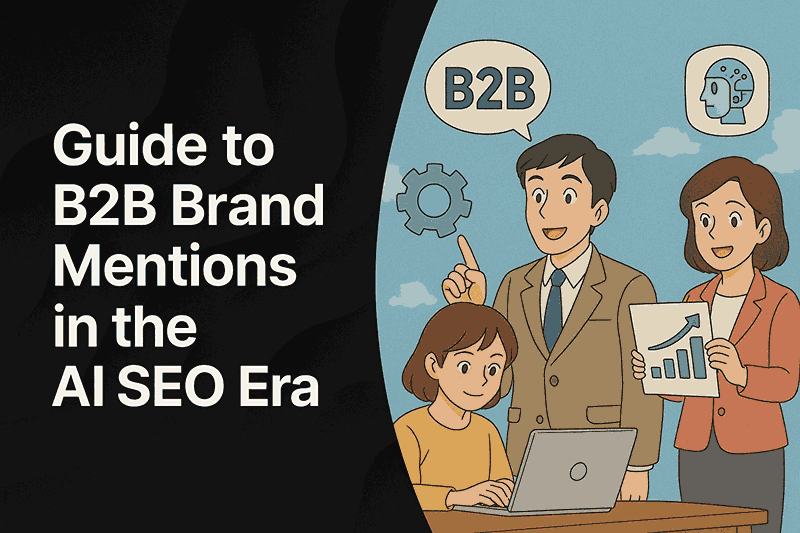

If you’re responsible for marketing or growth in a B2B company, you’ve probably heard the buzz around brand mentions – but what does it really mean today, especially as AI-powered search reshapes how content is discovered and consumed? In this post, I’ll walk you through the changing landscape, why B2B brand mentions matter more than ever, and how you can strategically build mentions that move the needle.
What Are Brand Mentions & Why They Matter Now More Than Ever
At its core, a brand mention is any time your company’s name (or a variation) appears in text – whether it’s in a blog post, industry report, social post (social mention), interview, or media article. It might include a hyperlink to your site (a linked mention), or simply be plain text without a link (an unlinked mention).
In the B2B world, brand mentions function as signals: signals that help search engines, AI systems, and human audiences understand that your brand is recognized, relevant, and authoritative.
Today, companies are also increasingly using brand monitoring tools to track these mentions across the web, helping them understand visibility, sentiment, and competitive positioning in real time.
The Concept of Entity Signals
In today’s evolving search ecosystem, especially with AI-driven algorithms, brands aren’t just evaluated on keywords and backlinks anymore. Now a days brands can’t ignore the SEO entities. Search engines pay attention to entities – recognized people, organizations, concepts – and their relationships to each other. A brand mention builds the entity footprint of your company, helping search engines and AI systems understand who you are, what you do, and how you relate to your industry.
According to Growth Partners Media, contextual brand mentions placed inside editorial content now signal authority, relevance, and trust at scale.
This shift means brand mentions aren’t just nice to have. They’re increasingly a core part of SEO and visibility in the AI-powered world.
How Search Engines Evaluate Brand Mentions
Understanding how search engines interpret mentions helps explain why they carry weight – and how you can benefit.
Entity Association
When your brand appears in varied contexts (e.g., across industry blogs, news, reports), search engines begin to associate it with relevant topics, sectors, or solutions. For example, if your B2B SaaS brand is mentioned in an article about AI-powered marketing automation, the algorithm may infer that your company is relevant to that domain. Over time, as mentions accumulate, your brand becomes part of a semantic network of related concepts – which boosts relevance whenever users search for those topics.
Semantic Relationships
It’s not just about frequency. Algorithms also look at the quality and context of mentions: who mentions you, where, and alongside which topics. A mention in a respected industry publication or research report carries more weight than a random casual mention on a small personal blog. This reflects a system’s growing ability to interpret semantic relationships – brand + subject matter + credibility domain.
According to recent coverage of SEO in 2025: Google’s AI-enhanced search no longer just follows links: It builds meaning from mentions.
E-E-A-T Influence (Experience – Expertise – Authoritativeness – Trust)
For B2B especially, where decisions are often high-stakes and involve multiple stakeholders, credibility matters. Brand mentions contribute to your E-E-A-T profile: when credible sources discuss or reference your brand, it sends a signal of authority and trustworthiness. SEO experts note that in B2B, organic visibility isn’t just about being found – it’s about being seen as reliable, capable, and experienced.
When AI generates answers (e.g., in search snippets, answer boxes, or summaries), brands with robust mention footprints stand a better chance of being surfaced – often ahead of brands with fewer mentions but more backlinks.
Types of Brand Mentions in B2B
Brand mentions come in many forms. Here are the major ones, especially relevant for B2B companies:
Implicit vs. Explicit Mentions
- Explicit mentions = your brand name appears directly (“Acme Marketing Solutions”).
- Implicit mentions = descriptions or references that obviously point to you without naming you (e.g., “the Mumbai-based SaaS vendor that does X”).
Both matter. Explicit mentions help build brand recognition; implicit ones strengthen semantic associations.
Media Mentions
This includes features of your brand in industry news, trade publications, press releases, interviews, podcasts, webinars – the kind of editorial or journalistic content that often carries authority. Media mentions are especially powerful because they typically come from third-party (and trusted) sources.
Listicle Placements & Round-Ups
Being included in “top 10 B2B marketing platforms” or “5 SaaS companies leading AI in 2025” lists adds social proof. It shows prospects that your brand is recognized by others and considered valuable enough to highlight – and that builds trust.
How Brand Mentions Impact B2B Buying Behavior
Brand mentions don’t just help SEO – they have real impact on how B2B buyers evaluate and decide.
Trust Signals
In B2B, purchases often involve multiple stakeholders, long sales cycles, and significant investments. Buyers don’t just look at features or price – they want trust and credibility. When they see your brand mentioned in respected publications, peer sites, or industry reports, it reassures them that others recognize and vouch for your company.
According to Ahrefs, 2025 SEO-statistics report: 61% of B2B buyers prefer a rep-free buying experience; 73% actively avoid suppliers that do irrelevant outreach.
That means many buyers won’t engage until they see reliable proof that a vendor is legitimate and trustworthy – and brand mentions help deliver precisely that proof.
Validation & Social Proof
Brand mentions function like peer recommendations. Think about it: if a prospect sees that other businesses, analysts, or respected voices have talked about your brand – especially in a positive or neutral context – it reduces friction. It’s social proof, but in a more professional, B2B context.
When buyers see repeated mentions of your brand – across blogs, interviews, reports – it validates your industry presence, signals consistency, and makes decision-makers more comfortable choosing you among alternatives.
Where to Get High-Quality B2B Mentions
Now the critical question: Where should you aim to get brand mentions? Not all mentions are equal – some will help more than others. Here’s where I’d target first, if I were building a B2B mention strategy today:
Industry Blogs & Niche Publications
Guest posts, thought leadership, or commentary pieces in respected industry blogs or niche publications are a great starting point. Because they’re contextually relevant, these mentions help define your brand as an authority in your niche.
I also recommend pitching case studies, insights, or industry analyses – not just promotional content. Thoughtful, data-driven content tends to get picked up, shared, and referenced.
Research Reports, Whitepapers & Industry Studies
Having your brand mentioned (or even quoted) in reports, whitepapers, or studies adds deep credibility. These sources are often used by other companies for benchmarking or decision-making – which means your mention will likely live on, referenced over time.
Interviews, Podcasts & Expert Round-Ups
Podcasts and interviews – especially in the B2B or industry-specific context – are surprisingly underutilized opportunities. They humanize your brand, showcase your expertise, and often lead to written show notes, transcripts, or summaries that include your mention.
Listicle placements and roundup articles on Top vendors or leading tools lists also work well: they combine editorial review with social proof, positioning your brand among peers.
How B2BMention Helps B2B Brands Get Mentioned
If you’re working at a B2B company – especially a SaaS or solution-based business – doing this all manually can be tough. That’s where a service like B2BMention can make a big difference.
Here’s how we help:
- We identify authoritative industry blogs, niche publications, podcasts, and research platforms that perfectly match your vertical.
- We craft thoughtful, value-driven content – from case studies to expert interviews – designed to attract high-quality mentions rather than promotional fluff.
- We manage outreach and relationship-building so you don’t have to, saving you time while increasing your brand’s visibility.
- We monitor and measure the impact of your mentions over time – not just in terms of backlinks, but in semantic authority, brand trust, and long-term SEO value.
If you’re ready to move beyond generic content and truly build your brand presence in the AI-driven SEO era – let’s talk about how B2BMention can help you get seen, cited, and respected.
Why Brand Mentions Are the New Competitive Advantage in 2026
Over the past decade, B2B marketing has leaned heavily on content marketing, keywords and links. But as AI-powered search reshapes the landscape, brand mentions are becoming a strategic differentiator.
Here are the biggest reasons I believe brand mentions should be central to any B2B marketing strategy in 2026:
- They build entity-level authority – not just page-level SEO.
- They help AI-driven search understand who you are, what you do, and why you matter.
- They serve as trust signals that influence complex, multi-stakeholder B2B buying decisions.
- They create social proof and validation, strengthening your brand in the eyes of prospects.
- Over time, they yield compounding visibility – every mention feeds future mentions, referrals, and discovery.
In 2025, organic search (backed by strong brand presence) remains one of the most effective channels for B2B revenue generation. According to SEMrush recent data: 70% of B2B marketers say SEO drives more sales than PPC.